Cochrane Library (Database Systematic Review), Issue 3. May 2023, published 21 July 2003.
Cochrane Library (Database Systematic Review), Issue 3. May 2023, published 21 July 2003.
Date of most recent amendment: 14 May 2003
Date of most recent substantive amendment: 09 April 2003
This review should be cited as: Siegfried N, Muller M, Volmink J, Deeks J, Egger M, Low N, Weiss H, Walker S, Williamson P. Male circumcision for prevention of heterosexual acquisition of HIV in men (Cochrane Review). In: The Cochrane Library, Issue 3, 2003. Oxford: Update Software.
The findings from observational studies, reviews and meta-analyses, supported by biological theories, that circumcised men appear less likely to acquire human immunodeficiency virus (HIV) has contributed to the recent ground swell of support for considering male circumcision as a strategy for preventing sexually acquired infection. We sought to elucidate and appraise the global evidence from published and unpublished studies that circumcision can be used as an intervention to prevent HIV infection.
We searched online for published and unpublished studies in The Cochrane Library (issue 2, 2002), MEDLINE (April 2002), EMBASE (February 2002) and AIDSLINE (August 2001). We also searched databases listing conference abstracts, scanned reference lists of articles and contacted authors of included studies.
We searched for randomized and quasi-randomized controlled trials of male circumcision or, in their absence, observational studies that compare acquisition rates of HIV-1 and HIV-2 infection in circumcised and uncircumcised heterosexualmen.
Independent reviewers selected studies, assessed study quality and extracted data. We stratified studies based on study design and on whether they included participants from the general population or high-risk groups (such as patients treated for sexually transmitted infections). We expressed findings as crude and adjusted odds ratios (OR) together with their 95% confidence intervals (CI) and conducted a sensitivity analysis to explore the effect of adjustment on study results. We investigated whether the method of circumcision ascertainment influenced study outcomes.
We identified no completed randomized controlled trials. Three randomized controlled trials are currently underway or commencing shortly. We found 34 observational studies: 16 conducted in the general population and 18 in high-risk populations. It seems unlikely that potential confounding factors were completely accounted for in any of the included studies. In particular, important risk factors, such as religion and sexual practices, were not adequately accounted for in many of the includedstudies.
General population study results:
The single cohort study (N = 5516) showed a significant difference in HIV transmission rates between circumcised and uncircumcised men [OR = 0.58; 95% CI: 0.36 to 0.96]. Results for the 14 cross-sectional studies were inconsistent, with point estimates for unadjusted odds ratios varying between 0.28 and 1.73. Six studies had statistically significant results, four in the direction of benefit and two in the direction of harm. The test for heterogeneity between the cross-sectional studies was highly significant (chi-square = 77.59; df = 13; P-value < 0.00001). Nine studies reported adjusted odds ratios with eight in the direction of benefit, ranging from 0.26 to 0.80. Use of adjusted results tended to show stronger evidence of an association although they remained heterogenous (chi-square = 75.2; df = 13; P-value < 0.00001). Only one case-control study was found (N = 51) which had a non-significant result [OR = 1.90; 95% CI: 0.50 to 7.20].
High-risk group study results:
The four cohort studies identified found a protective effect from circumcision with point estimates for unadjusted odds ratios varying from 0.10 to 0.39. Two of these studies had statistically significant results. Two studies reported adjusted odds ratios, both protective with one being significant. The chi-square test for between-study heterogeneity was not significant (chi-square = 5.21; df = 3; P-value = 0.16). All eleven cross-sectional studies reporting unadjusted results found benefit from circumcision, eight of which had statistically significant results. Estimates of effect varied from an unadjusted odds ratio of 0.10 to 0.66. Between-study heterogeneity was significant with the chi-square = 29.77; df = 10; P-value = 0.0009. Four of these studies reported adjusted odds ratios ranging from 0.20 to 0.59 and all were significant. One additional cross-sectional study only reported an adjusted odds ratio in the direction of benefit which was statistically significant. All three case-control studies found a protective effect of circumcision on HIV status, two being statistically significant. Point estimates varied from unadjusted odds ratios of 0.37 to 0.88. One reported an adjusted odds ratio showing a significant protective effect.
Adverse effects:
No studies reported on the adverse effects of circumcision. In most studies, circumcision had taken place during childhood or adolescence before the studies commenced.
We found insufficient evidence to support an interventional effect of male circumcision on HIV acquisition in heterosexual men. The results from existing observational studies show a strong epidemiological association between male circumcision and prevention of HIV, especially among high-risk groups. However, observational studies are inherently limited by confounding which is unlikely to be fully adjusted for. In the light of forthcoming results from RCTs, the value of IPD analysis of the included studies is doubtful. The results of these trials will need to be carefully considered before circumcision is implemented as a public health intervention for prevention of sexually transmitted HIV.
Siegfried N, Muller M, Volmink J, Deeks J, Egger M, Low N, Weiss H, Walker S, Williamson P. Male circumcision for prevention of heterosexual acquisition of HIV in men (Cochrane Review). In: The Cochrane Library, Issue 3, 2003. Oxford: Update Software.
Male circumcision is defined as the surgical removal of all or part of the prepuce (foreskin) of the penis and may be practiced as part of a religious ritual usually conducted shortly after birth or in childhood; as a medical procedure related to infections, injury or anomalies of the foreskin; or as part of a traditional ritual performed as an initiation into manhood (Horizons 00). For over a decade observational studies have suggested an association between male circumcision and HIV infection in males. Most of these studies suggest a protective effect of male circumcision on HIV acquisition in men.
Six reviews (Moses 94; De Vincenzi 94; Moses 98; Van Howe 99; Weiss 00; Bailey 01) and one meta-analysis (Weiss 00) of these observational studies have been published, reaching different conclusions on the association between male circumcision and HIV infection. However, search strategies are not clearly described in all the reviews, several focused only on published studies and confounding was not always assessed adequately. The most rigorous is a systematic review and meta-analysis of published studies on HIV-1 infection in sub-Saharan Africa recently published by Weiss et al. (Weiss 00). Adjusted analyses produced an odds ratio (OR) of 0.42 (95% CI: 0.34 to 0.54) for all studies combined (N=15) with an OR of 0.55 (95% CI: 0.42 to 0.72) for population-based cross-sectional studies (N=5) and an OR of 0.24 (95% CI: 0.18 to 0.31) for cross-sectional studies of high-risk groups (N=4). The authors conclude that there is compelling evidence that male circumcision is associated with a reduced risk of HIV infection in sub-Saharan Africa while warning that residual confounding may exist in some studies due to behavioural or biological factors that are unknown or unmeasured.
In this Cochrane review we are assessing the likelihood that use of circumcision as an intervention will reduce transmission of HIV infection to men. Thus our review differs in aim from previous reviews which have concentrated on assessing evidence of the association between circumcision and HIV. While randomised controlled trials are the ideal method for proving a causal effect of an intervention, observational studies may also provide weaker evidence of causality when the participants and exposure (circumcision) match what is likely to happen in an intervention programme, and when other confounding factors can be excluded.
Known sources of confounding identified by all the above reviews include sexual behaviour, penile hygiene and religion. Circumcision itself may be a proxy measure of the knowledge and behaviour learnt during the process of initiation during which time young men are taught about traditional sexual practices, including monogamy, and penile hygiene. A potential confounder that has not been measured in any study to date, to our knowledge, is the use of vaginal drying agents in female partners of the men. This practice is reportedly common in parts of Africa (Brown 93; Runganga 95; Kun 98) and may result in increased vaginal abrasions and micro-lacerations, possibly facilitating HIV transmission to both men and women. Viral load is increasingly considered to be a crucial factor in HIV transmission (Quinn 00) and may be both an important confounder and an effect modifier. Misclassification of exposure is also an important source of bias given that some studies classify circumcision status by self-report rather than direct observation.
Theories to support the biological basis for a protective effect of circumcision on HIV exist. Researchers have noted that the inner aspect of the foreskin is well-supplied with Langerhans cells (Szabo 00) and that in vitro, HIV-1 demonstrates a specific tropism (attraction) for these cells (Soto-Ramirez 96), in particular the CD4 receptors (Hussain 95) on them. CD4 and other HIV co-receptors have been shown to facilitate HIV entry into host cells. According to this theory, circumcision would remove the potential entry site for HIV. However, not all Langerhans cells are removed during circumcision as even after the procedure, there is residual penile mucosa of the glands and there are also Langerhans cells in the penile shaft (Cold 99). In direct contradiction to the above theory, the inner prepuce contains apocrine glands which secrete lysozyme (Fleiss 98). Lysozyme reportedly kills HIV-1 in vitro (Lee-Huang 99), suggesting a protective effect of the foreskin. As the study of the immunological function of the prepuce is not well-developed (Cold 99), caution must be observed when assuming in vitro viral behaviour is equivalent in vivo. In a recent study that used immunofluorescence and image analysis to quantify cells expressing HIV-1 co-receptors, adult foreskin mucosa had greater susceptibility to infection than cervical mucosa or the external surface of the foreskin tissue (Patterson 02).
The presence of a sexually transmitted infection (STI) enhances HIV infection and susceptibility (Grosskurth 95a; Cohen 98; Fleming 99). The role circumcision may play in the prevention of transmission of STIs is less certain, although it has been reported that male circumcision is associated with a reduced risk of genital ulcer disease, particularly chancroid and syphilis (Moses 98). It would therefore be valuable to examine the effectiveness of male circumcision for preventing acquisition of STIs through heterosexual intercourse. Should this relationship prove to be temporal, it is possible that circumcision may protect against HIV infection indirectly via decreased STI transmission.
Circumcision practices are largely culturally determined and as a result there are strong beliefs and opinions surrounding its practice. It is important to acknowledge that researchers' personal biases and the dominant circumcision practices of their respective countries may influence their interpretation of findings.
Given the enormous mortality and morbidity associated with HIV/AIDS, it seems reasonable to fully explore potential prevention measures, including male circumcision. However, promoting or instituting mass circumcision may have profound cultural and social implications and represents a formidable public health challenge (Cohen 00). The risk of surgical wound infection following circumcision must be considered. Of particular concern is the potential negative impact introduction of circumcision may have on current health promotion endeavours to promote sexual behavioural change. If circumcision were actively promoted as an HIV prevention measure, there is some risk that men might seek circumcision in the belief that they can become fully protected from HIV, resulting in a lack of condom use. The following systematic review seeks to inform this debate by presenting the evidence from both published and unpublished studies which examine the association between male circumcision and HIV-1 and HIV-2 infection by heterosexual intercourse.
Randomised or quasi-randomized controlled trials. We pre-specified that should data be insufficient, i.e., no randomised controlled trials (RCTs) identified, data from observational studies (e.g. cohort, case-control and cross-sectional studies) would be considered for inclusion in this review according to the HIV/AIDS Cochrane Review Group policy (HIV CRG). Studies performed in general or specific populations and in hospitals or clinics were included. Studies performed in any country and published in any language were included. Studies with historical controls and ecological studies were excluded as these provide unreliable data for determining causation and/orassociation.
Heterosexual men included in studies assessing the association between circumcision and HIV-1 and HIV-2. Men are defined as males 12 years of age or older.
Male circumcision is defined as removal of the foreskin of the penis either as a medical intervention or via cultural or religious practices that involve cutting off the foreskin. Circumcision status was determined by self- or partner-report or by direct observation.
The outcome measures were:
HIV-1 or HIV-2 infection (incidence or prevalence) in men, based on laboratory results;
Any adverse events associated with circumcision were recorded if reported in the studies.
See: Cochrane HIV/AIDS Group search strategy
See: Collaborative Review Group search strategy
hiv 1[MeSH Terms] OR
hiv 2[MeSH Terms]) OR HIV
hiv infections[MeSH Terms]
This yielded 152 abstracts. We did not limit the search by using methodological filters (e.g. only searching for RCTs). [We initially searched linking HIV
and risk factors
without limiting the search to circumcision
. However, this search yielded over 12,000 citations and we decided that any additional studies obtained from this search would not justify the additional time and resources to appraise 12,000 abstracts.] We also did not search using terms for sexually transmitted infections
.
This yielded 143 abstracts.
This yielded a total of 360 abstracts. We were unable to locate many of the authors of abstracts of potentially eligible studies presented during the 1980s and early 1990s. Many of these abstracts may overlap with published studies included in this review, but we were unable to confirm this in many cases. Further assessment of the abstracts is currently underway and results will be included in future updates of the review.
The titles, abstracts and descriptor terms of all downloaded material from the electronic searches were read by NS and MM and irrelevant reports were discarded. All citations identified were then independently inspected by NS and MM to establish relevance of the article according to the pre-specified criteria. Where there was uncertainty as to the relevance of the study, the full article was obtained.
1. Selection of studies
NS and MM independently applied the inclusion criteria, and differences were resolved by discussions with a third reviewer, JV. Studies were reviewed for relevance based on study design, types of participants, exposures and outcome measures.
2. Data extraction
Data were extracted independently by NS and MM. No RCTs were found. Standardised data extraction forms - one for cohort/cross-sectional studies and one for case-control studies - were used. The following characteristics were extracted from each included study:
Administrative details
Identification; author(s); published or unpublished; year of publication; number of studies included in paper; year in which study was conducted; details of other relevant papers cited;
Details of study
Study design; method(s) of recruitment; inclusion and exclusion criteria; number of participants assessed for eligibility, number excluded, number enrolled, number analysed; type, duration, frequency and completeness of follow-up in the case of cohort studies; country and location of the study; setting in which the study was performed (e.g., urban or rural; general population, occupational or hospital/clinic based); background HIV prevalence in the general population; background religion in the general population; background HIV prevalence of the selected study population (high-risk or low-risk); number of participants; dominant cultural practices regarding circumcision (age of circumcision and reason);
Characteristics of participants
Age; location; education; occupation; religion; socio-economic status; marital status; age at first intercourse; number of sexual partners; contact with sex workers; condom use; other identified risk factors (e.g., presence of sexually transmitted infections; injection; blood transfusion);
Details of intervention
Circumcision based on self- or partner-report or direct observation; age at circumcision; circumcision procedure used (surgical procedure or traditional); reason for circumcision (traditional beliefs or medical treatment); whether assessors of circumcision were blinded to HIV status;
Details of outcomes
Incidence and prevalence of HIV infection: HIV-1, HIV-2, both or unclear; number of HIV positive and HIV negative men in the circumcised and uncircumcised groups (n/N) (except for case-control studies, where number of men circumcised in the case and control groups were recorded); types of tests used to determine and confirm HIV status; whether assessors of HIV status were blinded to circumcision status; method of surveillance of adverse effects associated with circumcision; number of men with specific adverse effects associated with circumcision (n/N);
Details of analysis
Reported crude and adjusted measures of effect and confidence intervals were extracted where presented. Odds ratios were calculated for each study. When adjusted analysis was performed, type of analysis and factors adjusted for were recorded;
Details of study ethics
informed consent obtained for participation; approving institution (s).
3. Quality assessment
Randomized Controlled Trials (RCTs): No RCTs were identified.
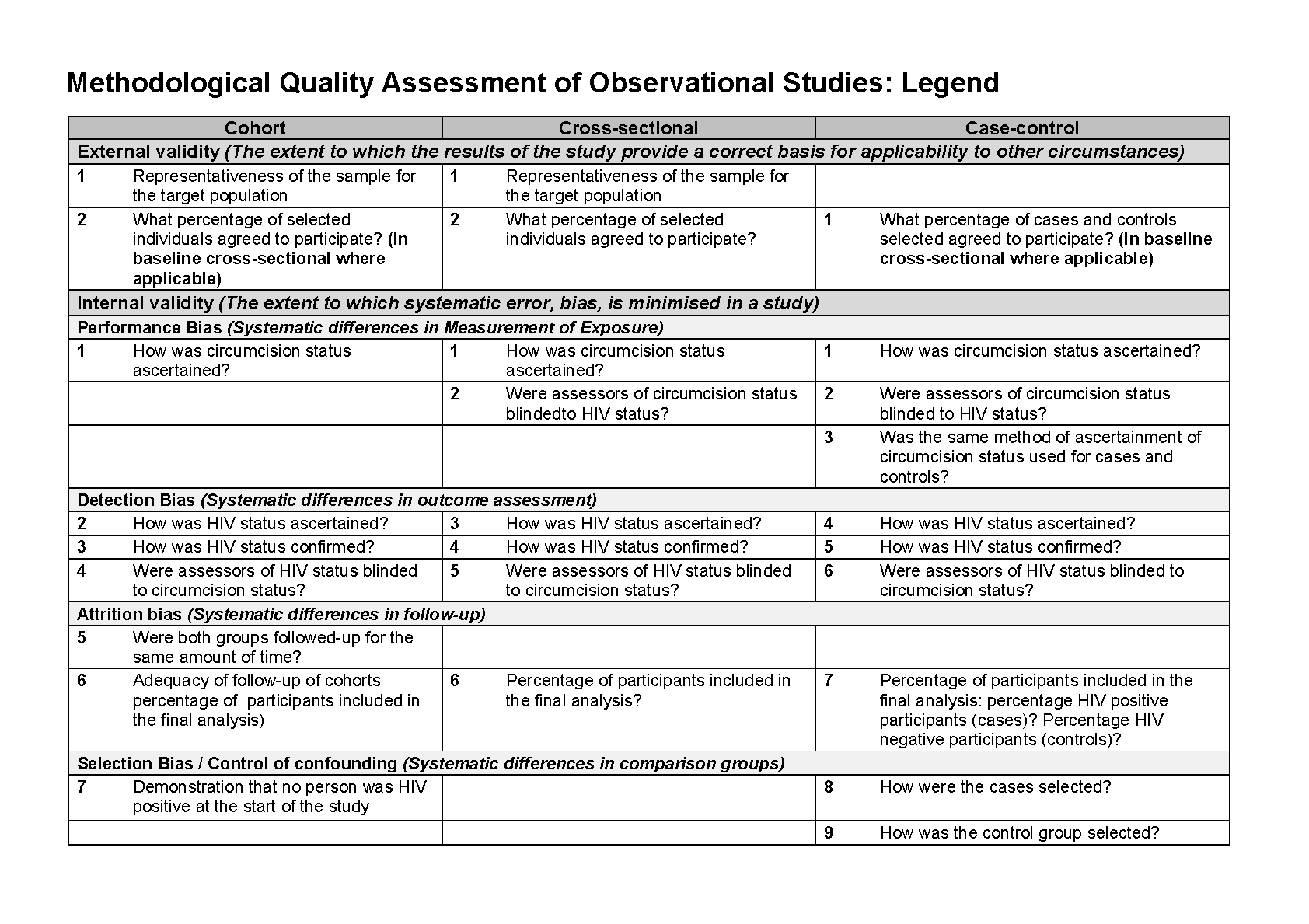
Observational studies: Quality assessment of observational studies was undertaken using standardised quality assessment forms developed by the reviewers specifically for the review (see , ). Aspects of the quality assessed are listed below. Some items were only evaluated in cohort studies (CT), cross-sectional studies (CS) or case-control studies (CC).
(a) External validity
- was the sample a census, consecutive sample or random sample? (CT, CS)
- were at least 80% of those eligible to participate in all groups recruited?
(b) Performance bias
- was circumcision status ascertained by genital examination (direct observation)?
- were assessors of circumcision status blinded to HIV status? (CC, CS)
- was the same method of ascertainment used in cases and controls? (CC)
(c) Detection bias
- was HIV status ascertained using an ELISA test, Western blot or particle agglutination test?
- was HIV status confirmed using a different or second test from this list?
- were assessors of HIV status blinded to circumcision status (or tests undertaken in an independent laboratory)?
(d) Attrition bias
- were circumcised and uncircumcised groups followed for the same time? (CT)
- were at least 80% of participants in all groups included in the final analysis or was the description of those not included not suggestive of bias?
(e) Selection bias
- were all participants shown to be HIV negative at start of study? (CT)
- were cases selected from the general population? (CC)
- were controls selected from the same population as the cases? (CC)
(f) Control of confounding
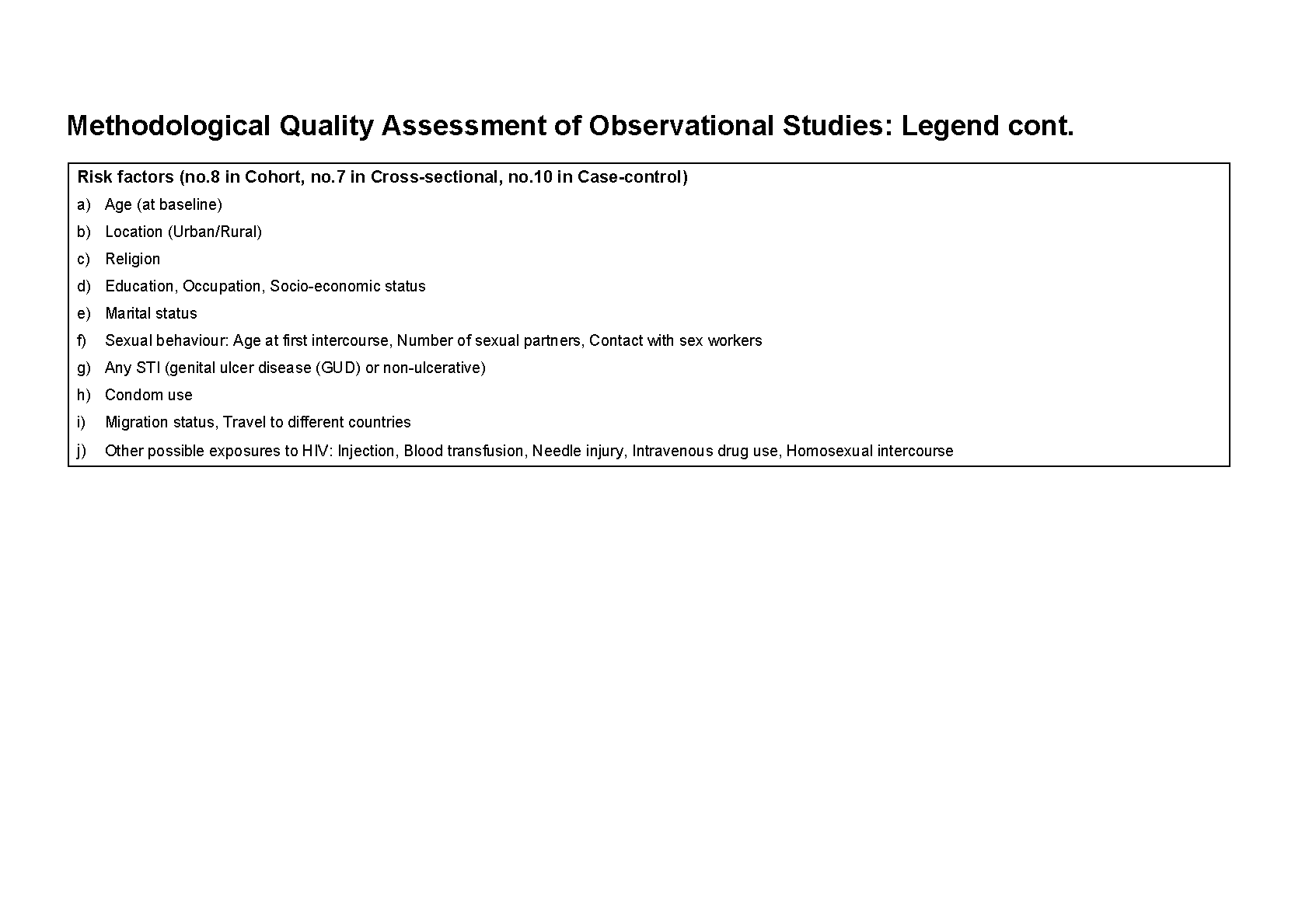
- the following factors were pre-specified by the review team as potential confounders, and it was noted whether they were demonstrated to be similar in both groups, matched in the design or adjusted for in the analysis. The item received an asterisk (*) if the factor was balanced between circumcised and uncircumcised groups (CS and CT) or between HIV positive and negative groups (CC), matched, or adjusted for in the analysis. An absence of an (*) indicates that the factor was either not measured or, if it was, it did not meet the (*) requirements.
(1) age at baseline
(2) study location (urban / rural)
(3) religion
(4) education, occupation, socio-economic status
(5) marital status
(6) sexual behaviour: age at first intercourse, number of sexual partners, contact with sex workers
(7) any sexually transmitted infection (genital ulcer disease (GUD) or non-ulcerative disease)
(8) condom use
(9) migration status and travel to different countries
(10) other possible HIV exposures, including injections, blood transfusions, needle injuries, intravenous drug use, homosexual intercourse
The methodological quality of the included cohort, case-control and cross-sectional studies was evaluated independently by NS and MM. One further reviewer (JD) checked the use of quality assessment. Reviewers were not blinded to the names of the authors, institutions, journal of publication or results of the studies.
4. Data synthesis
Incomplete data
Where data were incomplete, attempts were made to contact the authors for clarification of important information. This was successful in a number of instances and acknowledgement of this is included in the Table of Included Studies.
Outcome measures
All outcomes included in this review are binary. Measures of association for each study are expressed as odds ratios together with their 95% confidence intervals. Due to current limitations in software we present only unadjusted odds ratios in the METAVIEW figures. When adjusted odds ratios were reported, we note these in the QUALITY WEBTABLE. When graphical depiction of adjusted odds ratios becomes possible, such plots will be included in an update of the review.
In the protocol we pre-specified that meta-analysis would be conducted if data allowed and where appropriate. However, due to the heterogeneous results this was not appropriate and a narrative synthesis was undertaken. More details are given in the RESULTS section. The results are presented graphically as forest plots in METAVIEW. The Chi-square test for heterogeneity was used to provide an indication of between-study heterogeneity as pre-specified in the protocol. In addition, the degree of heterogeneity observed in the results was quantified using the I-squared statistic (Higgins 02) which can be interpreted as the percentage of variation observed between the studies attributable to between-study differencesrather than the play of chance.
Stratified analysis
Studies are presented stratified by study design and within study design, and further stratified by general population/high risk group as pre-specified in the protocol.
Investigations of heterogeneity
The protocol pre-specified investigating the impact of method of circumcision ascertainment, HIV-1 and HIV-2, background prevalence and publication status on study findings. Only the first factor could be investigated with the data obtained. Meta-regression to explore the effect of risk group and study design on the adjusted results was conducted using STATA.
Sensitivity analysis
The protocol pre-specified doing a sensitivity analysis to assess the impact of using adjusted rather than crude results and published versus unpublished results. As no meta-analysis was conducted, we were not able to conduct a quantitative sensitivity analysis but instead provide a narrative description of the differences between crude and adjusted results. Direct evidence of publication bias could not be investigated as only two unpublished studies were obtained. Excessive heterogeneity in study results prevented use of indirect tests for publication bias, such as funnel plots.
See Table of Included studies. Please note that the sixth column: Allocation Concealment, is not applicable to this review as no RCTs wereidentfied.
No completed randomised controlled trials were identified. However, the authors are aware of a RCT already underway in Kisumu, Kenya (Bailey 02) and another trial which was scheduled to commence in Rakai, Uganda in March 2002 (Gray 02). The Kisumu trial will have a completed sample size of 2,276 in total and the Rakai trial will have 2500 men in each of two groups. A third trial (Auvert 03), with a sample size of 3,500, commenced in Gauteng Province in South Africa in 2003.
Altogether we identified 35 observational studies which met review inclusion criteria. Sixteen of these studies had been conducted in general population settings, and 19 had been conducted in high-risk population settings. We defined high-risk studies as those studies conducted in settings where HIV infection rate is either known to be high or the setting provides conditions conducive to the spread of HIV. In this review high-risk studies were those conducted in sexually transmitted infection (STI) clinics, hospital and outpatient departments, specific high-risk occupational groupings, such as long-distance truck drivers, and prison settings.
The observational studies were of three different designs. Typically their objectives were to investigate multiple risk factors for HIV infection with no specific focus on the role of circumcision. Twenty-five studies were cross-sectional surveys undertaken at a single time point. Participants were tested for HIV at the same time that risk factors were elicited. Five of the studies were cohort incidence studies which followed a group known to be HIV-negative over time, identifying new cases by repeated HIV testing. Risk factors for infection were usually elicited at baseline. Several cohort studies were based on groups identified as HIV-negative in a cross-sectional study. Four studies were of case-control designs, where the prevalence of potential risk factors for HIV in a sample of cases known to be HIV positive was compared with the prevalence in a control sample known to be HIV-negative.
Please see Table of Included Studies under NOTES for a detailed narrative description of the qualityfor each included study.
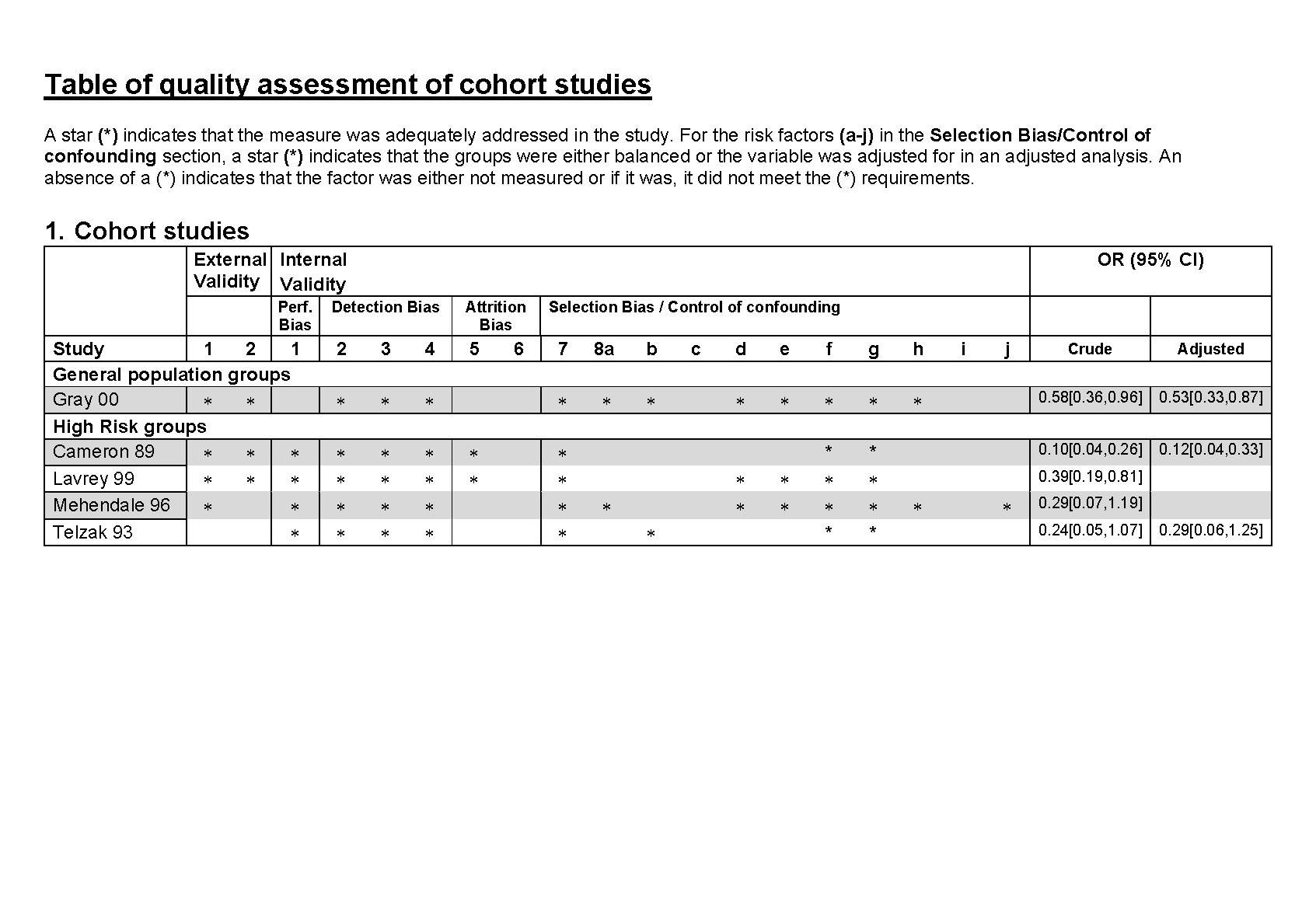
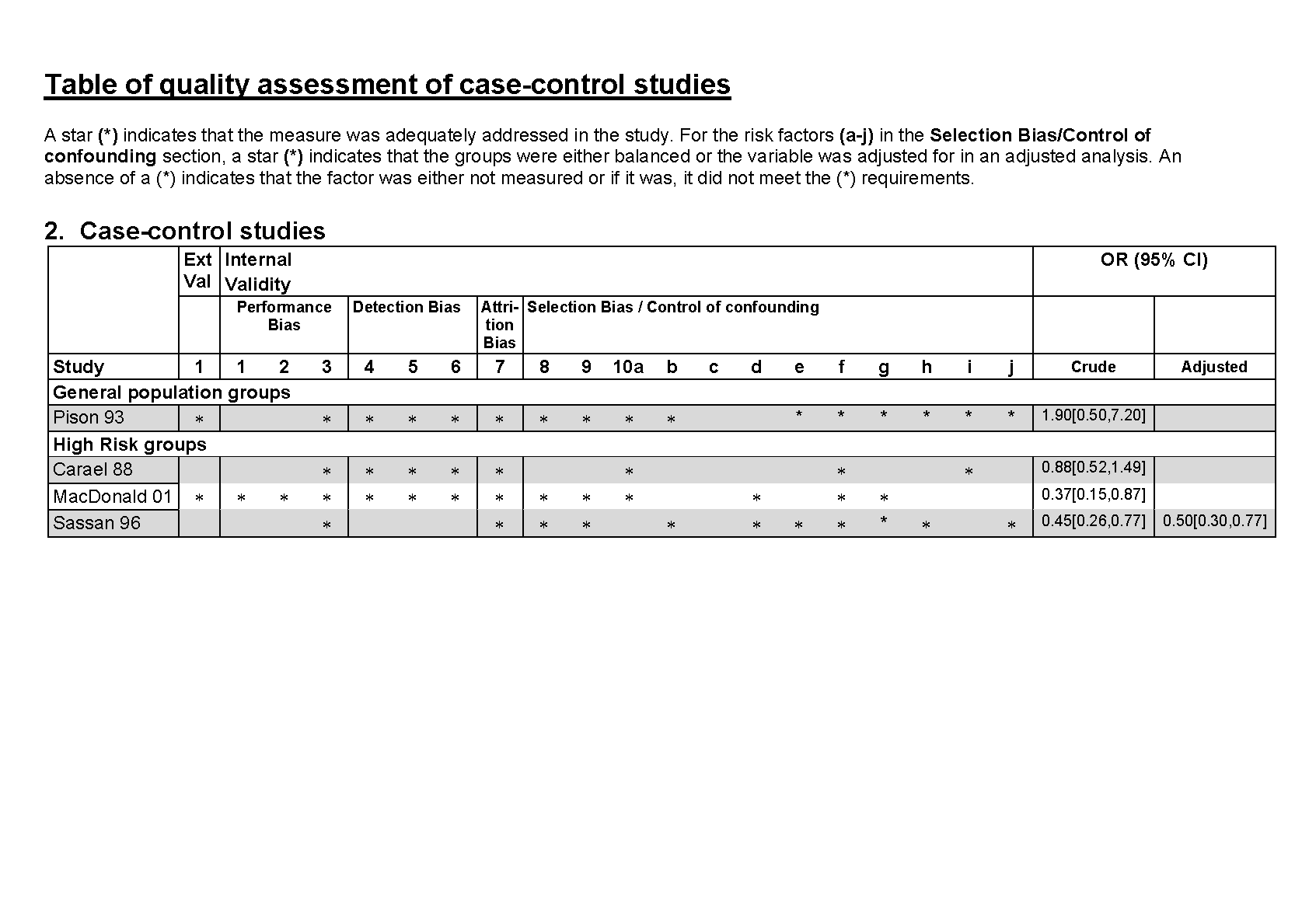
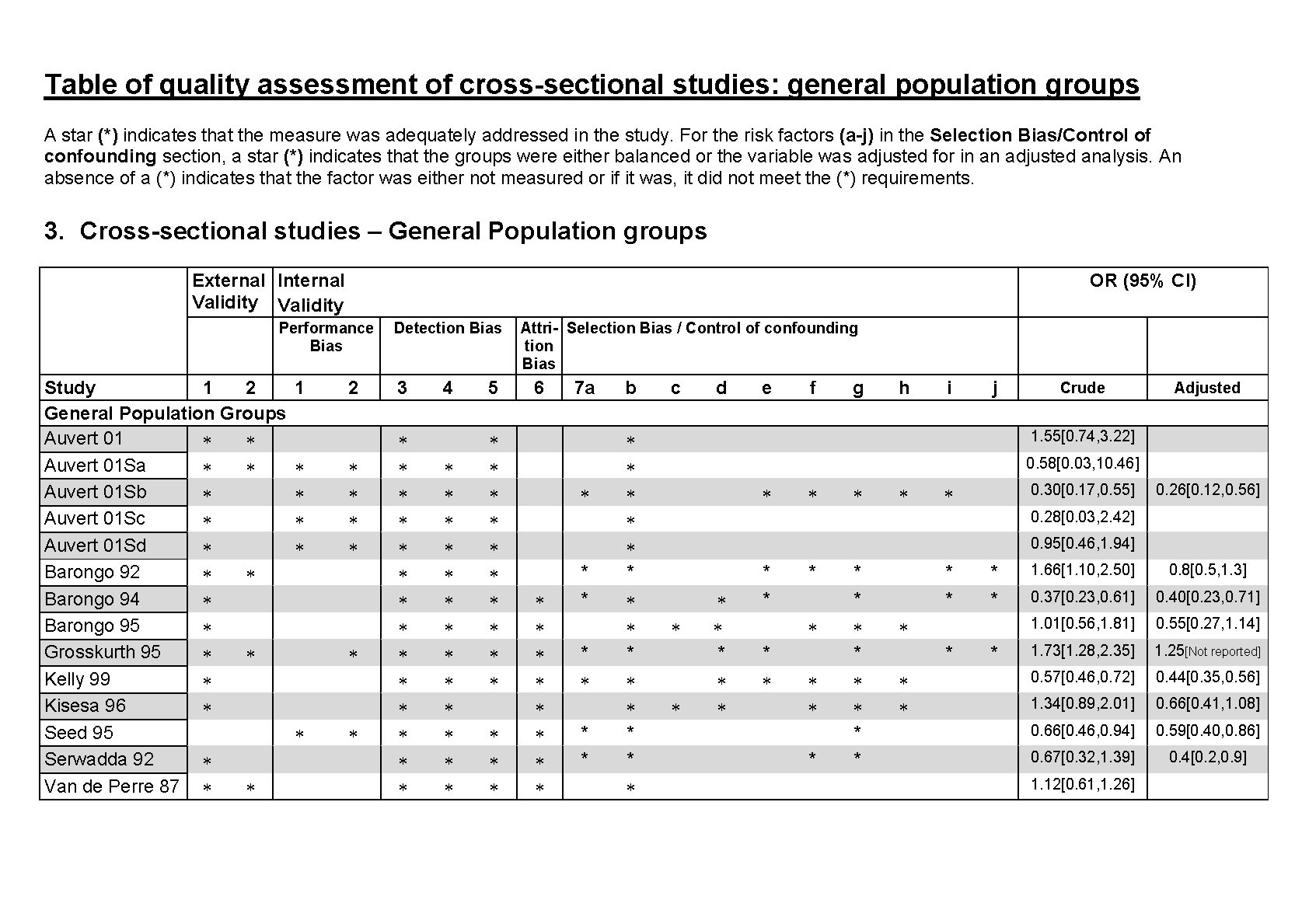
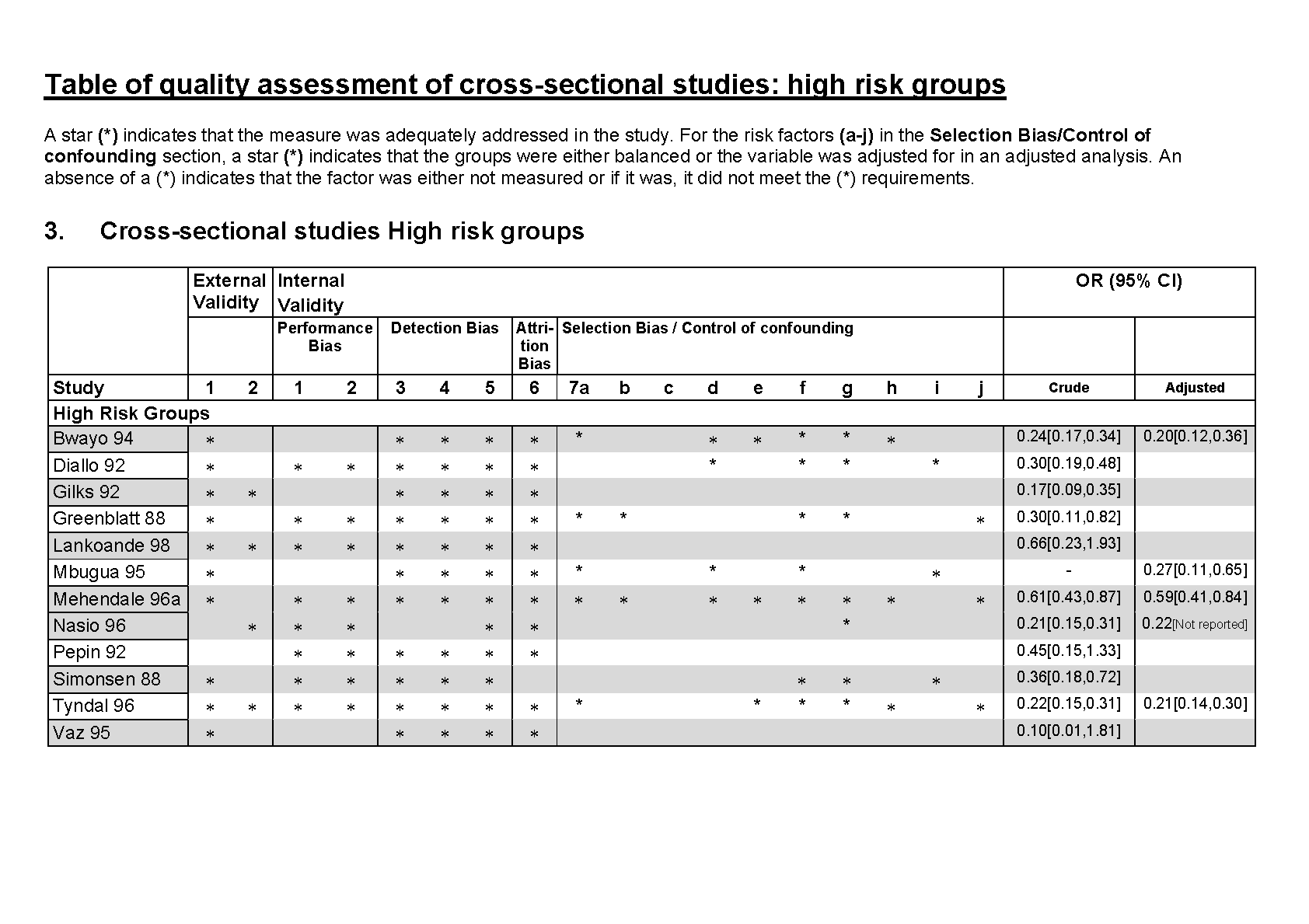
A table of graphic representation of the qualityof each study is contained in , , and .
Overall study quality was highly variable.
Performance bias (misclassification of exposure) may be present in all studies where circumcision status was obtained by self-report rather than direct observation. Fifteen studies assessed circumcision status by self-report and 20 by direct observation.
Detection bias was rare across all studies as nearly all studies (n=33) used blinded methods for assessing and confirming HIV status.
All five cohort studies included in the review were susceptible to attrition bias as loss-to-follow-up was greater than 20% (Mehendale 96; Lavrey 99), unequal between circumcised and uncircumcised groups (Cameron 89), or unclear (Telzak 93; Gray 00).
Selection bias was problematic in all studies, and results were potentially confounded by other risk factors for transmission of HIV, such as sexual behaviour and religion. Circumcised and uncircumcised groups (in cohort and cross-sectional studies) and HIV-positive and HIV-negative groups (in case-control studies) were seldom balanced for all or most of the ten risk factors that we identified as potential confounders prior to the quality assessment (see ). Statistical adjustments for measured confounding factors were made in 14 of the 35 included studies. The adjusted confounders differed across studies in number and type.
We stratified the studies according to whether they were conducted in the general population or whether they were conducted in high risk groups. The studies were further stratified according to study type i.e. cohort, cross-sectional and case-control studies. Our protocol specified that meta-analysis would be conducted within these strata, where appropriate. However, meta-analysis was not performed as many of the studies had a high likelihood of bias and heterogeneous results, suggesting that any overall summary statistic is likely to be misleading. Synthesis focused on describing the direction and consistency of effect, assessing the likelihood of bias, and investigating factors that may explain differences between the results of studies. We used the odds ratio to permit comparison of results of cross-sectional and cohort studies with those of case-control studies, for which the odds ratio is the only valid estimator of effect. Odds ratios greater than 1 indicate increased risk of HIV infection with circumcision and odds ratios less than 1 indicate decreased risk of HIV infection withcircumcision.
GENERAL POPULATION STUDY RESULTS:
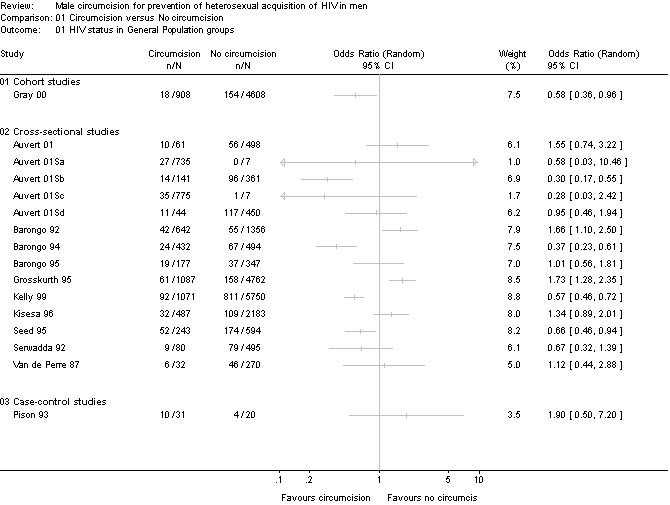
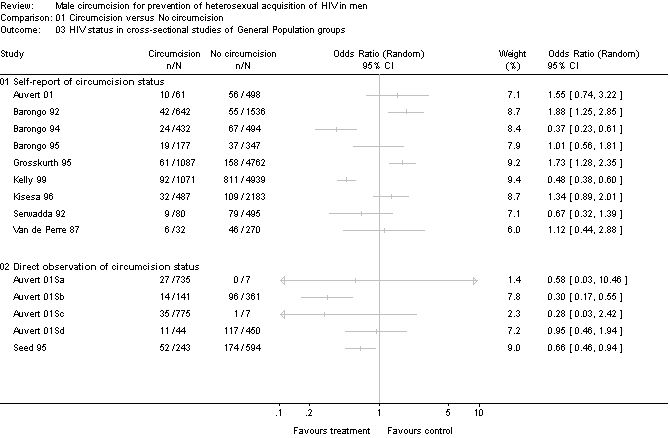
We identified one cohort study, 14 cross-sectional studies and one case-control study conducted in the general population. The unadjusted results are graphically depicted in Table 01 in METAVIEW. The adjusted results are presented in, and .
The single cohort study (Gray 00) (N = 5,516) showed a significant difference in HIV transmission rates between circumcised and uncircumcised men [OR = 0.58; 95% CI: 0.36 to 0.96]. The adjusted OR was 0.53 (95% CI: 0.33 to 0.87).
The 14 cross-sectional studies (Van de Perre 87; Barongo 92; Serwadda 92; Barongo 94; Barongo 95; Grosskurth 95; Seed 95; Kisesa 96; Kelly 99; Auvert 01; Auvert 01Sa; Auvert 01Sb; Auvert 01Sc; Auvert 01Sd) had inconsistent findings. Eight studies were in the direction of benefit whilst six were in the direction of harm, with point estimates of odds ratios varying between 0.28 and 1.73. Six studies had statistically significant results, four in the direction of benefit and two in the direction of harm. The test for heterogeneity was highly significant (chi-square = 77.59; df = 13; P-value < 0.00001). Eighty-six percent of the variability observed between the studies was attributable to between-study differences and not random variation. Nine studies reported adjusted odds ratios with eight in the direction of benefit, ranging from 0.26 to 0.80. Use of adjusted results tended to show stronger evidence of an association although they remained heterogenous (chi-square = 75.2; df = 13; P-value < 0.00001), 83% of the variability in adjusted results not being explicableby chance alone.
Only one case-control in a general population setting was included (Pison 93). This study was small (N = 51) and found no significant difference in HIV transmission rates between circumcised and uncircumcised men [OR = 1.90; 95% CI: 0.50 to 7.20].
HIGH-RISK GROUP STUDY RESULTS
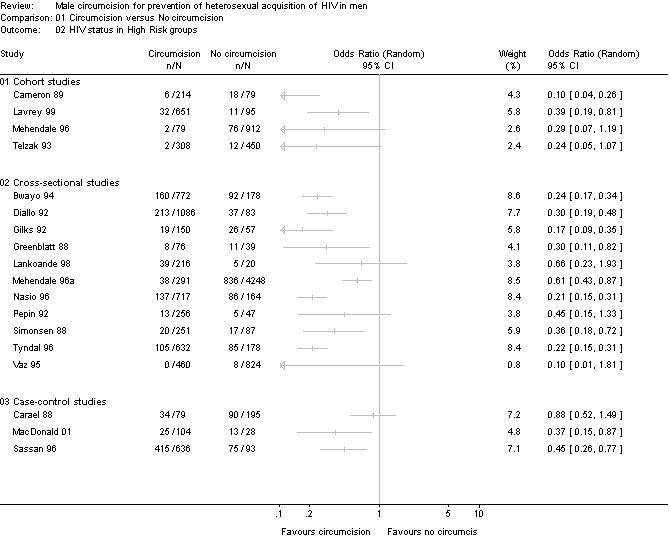
We identified four cohort studies, 12 cross-sectional studies and three case-control studies conducted in high-risk groups. The unadjusted results are graphically depicted in Table 02 in METAVIEW. The adjusted results are presented in , and .
The four cohort studies (Cameron 89; Telzak 93; Mehendale 96; Lavrey 99) were all in the direction of benefit from circumcision and two of them had statistically significant results. Point estimates varied from odds ratios of 0.10 to 0.39. The chi-square test for between-study heterogeneity was not significant (chi-square = 5.21; df = 3; P-value = 0.16). However, 42% of the variability in results was not explicable by chance. The studies were clinically diverse: two were conducted in Kenya, one in truck drivers (Lavrey 99), and the other in a STI clinic (Cameron 89); the third study was conducted in a STI clinic in India (Mehendale 96) and the fourth in a STI clinic in New York City (Telzak 93).
Unadjusted results from 11 cross-sectional studies (Greenblatt 88; Simonsen 88; Diallo 92; Gilks 92; Pepin 92; Bwayo 94; Vaz 95; Mehendale 96a; Nasio 96; Tyndal 96; Lankoande 98) were in the direction of benefit, eight being statistically significant. Estimates of effect varied from odds ratios of 0.10 to 0.66. Between-study heterogeneity was significant with the chi-square = 29.77; df = 10; P-value = 0.0009. Sixty-six percent of the variability in results was not explicable by chance. Four of the cross-sectional studies report adjusted odds ratios ranging from 0.20 to 0.59, and all were significant. One additional study (Mbugua 95) only reported an adjusted odds ratio in the direction of benefit which was statistically significant; no data were provided to calculate an unadjusted odds ratio.
Three case-control studies (Carael 88; Sassan 96; MacDonald 01) met inclusion criteria and were all in the direction of a protective effect of circumcision on HIV status, two being statistically significant. Point estimates varied from odds ratios of 0.37 to 0.88. The test for between-study heterogeneity was marginal (chi-square = 4.36; df = 2; P-value = 0.11). Fifty-four percent of the variation in results could not be explained by the play of chance. One study (Sassan 96) reported an adjusted OR of 0.50 (95% CI: 0.30 to 0.77).
SUB-GROUP ANALYSIS
Our pre-specified decisions to stratify results by risk group and study design was supported by the results of the studies. Studies in high-risk groups were significantly more in favour of circumcision than those done in general-population studies (P-value = 0.001 by meta-regression of adjusted results), and differences were observed between study designs for the high-risk studies (P-value = 0.03 for cross-sectional compared with case-control; P-value = 0.06 for cohort compared with case-control). Insufficient numbers of cohort and case-control studies were included to make the same comparison amongstgeneral-population studies.
We were able to conduct a sub-group analysis on mode of establishing circumcision status: self-report versus direct observation. Due to the small number of studies in some strata, it was only possible to do this for cross-sectional studies within the general population group (Table 03 METAVIEW). All five cross-sectional studies using direct observation indicated a benefit of circumcision (observed odds ratios ranged from 0.28 to 0.95), while the nine studies based on self-report reported a mixture of benefit (three studies) and harm (six studies) (odds ratios ranging from 0.37 to 1.88). Between-study heterogeneity was suggested in the sub-group of self-reported studies (chi-square = 80.66; df = 8; P-value < 0.00001). The test for heterogeneity was marginal in the direct observation sub-group (chi-square = 7.21; df = 4; P-value = 0.13). The difference between the groups did not reach statistical significance (P-value = 0.12). Results from studies using direct observation were still heterogeneous, 45% of the observed variability not beingexplicable by chance.
We were not able to conduct sub-group analysis on HIV-1 versus HIV-2 status as many studies did not clearly report on the type of HIV, and those studies which measured both often did not differentiate between the two types in analysis. Twenty of the studies assessed HIV-1 status only, one study only included HIV-2, six studies included both HIV-1 and HIV-2 and five studies were unclear whether HIV-1 or HIV-2was measured.
We were also not able to conduct sub-group analysis on background prevalence of HIV in the sampled populations as this information was unavailable for almost all studies.
SENSITIVITY ANALYSIS
A sensitivity analysis was planned to examine the difference between crude and adjusted estimates of treatment effects. Seventeen studies reported both crude and adjusted effects. In general, adjustment made little difference to the size, direction or significance of effects in eleven studies. The six studies with substantial differences between crude and adjusted results all changed in favour of a protective effect of circumcision. In three, both unadjusted and adjusted results were not significant (Barongo 95; Kisesa 96; Kelly 99). In Barongo 92, while the unadjusted result indicated significant harm (OR = 1.66; 95% CI: 1.10 to 2.50), the adjusted result suggested a benefit (OR = 0.80; 95% CI: 0.50 to 1.30) albeit non-significant. In Serwadda 92 a non-significant unadjusted odds ratio of 0.67 (95% CI: 0.32 to 1.39) became a statistically significant adjusted odds ratio of 0.40 (95% CI: 0.20 to 0.90). In Grosskurth 95a a significant crude odds ratio of 1.73 (95% CI: 1.28 to 2.35) reduced to an adjusted odds ratio of 1.25 although information about its significance was not reported. All these studies were cross-sectional studies in the general population. Use of adjusted results where available made little difference in the observed degree of heterogeneity
We had hoped to conduct a sensitivity analysis looking at published versus unpublished studies, but only two unpublished studies (Barongo 95; Kisesa 96) were included in the review.
INDIVIDUAL PATIENT DATA ANALYSIS
In the light of forthcoming results from RCTs, we determined that it would not be of value to further explore the results of the included studies using IPD analysis. IPD analysis is dependant on obtaining original data. When we contacted authors we enquired whether they would be able to provide us with the original data. In most cases, authors stated that this would not be possible. An IPD analysis would thereforenot be feasible.
ADVERSE EFFECTS
No studies reported on the adverse effects of circumcision. In most studies, exposure to circumcision had taken place during childhood or adolescence, before the studies commenced.
CHOICE OF MAJOR PUBLICATION
A number of the included studies are described in more than one publication. In some cases, additional analyses conducted after completion of a study were reported in additional publications. Where methods of study design were described in additional publications, we used both reports to inform our data extraction. Where additional analyses were conducted, we chose to include one of the studies as the primary study as described below.
Five studies underwent re-analysis to specifically assess the association between male circumcision and HIV prevention, in an article by Urassa et al. (Urassa 97). We used the original articles and reports (two unpublished) to report the methods and quality assessment and to calculate the unadjusted odds ratios of the five included studies (Barongo 92; Barongo 94; Barongo 95; Grosskurth 95a; Kisesa 96). Adjusted odds ratios for the individual studies reported in Urassa 97 are included in our results.
An article by Quigley et al. (Quigley 97) reports on a case-control study nested within the cross-sectional study Grosskurth 95a and therefore reports on a sample of the same individuals included in the cross-sectional study. We report only the results of the cross-sectional study to avoid duplication.
Information for the included cohort study, Gray 00, was obtained from two articles (Wawer 99; Gray 00). Individuals were followed-up by home visits every 10 months and the study duration was 20 months in the trial reported in Wawer 99. However, cohort surveillance was continued beyond 20 months and was reported in Gray 00. We therefore chose to include the results for the longer follow-up period. An additional analysis of a subsample of the cohort reported in Gray 00 followed HIV-discordant couples over time. These were identified retrospectively in 1999. Linked data on the sero-status of partners was not available during the conduct of the study (1994 to 1998). We therefore did not include this sub-sample as the men were already included in the general population cohort, to avoid duplication.
There are currently no RCTs assessing the effectiveness of male circumcision in preventing HIV acquisition in heterosexual men. However, three large trials, Bailey 02 (N = 2776), Gray 02 (N = 5000) and Auvert 03 (N=3500) are currently underway and are scheduled for completion in 2005/06. Properly conducted RCTs are regarded as the best method of assessing the effectiveness of health care interventions as they generate comparable intervention and non-intervention groups with the only differences between the groups being attributable to the effect of the intervention, or chance (Kleijnen 97).
Due to the lack of RCT evidence, and prompted by publication of other reviews that reported that male circumcision provides a protective effect on HIV acquisition in heterosexual men, we assessed the evidence of the benefits of circumcision available from observational studies. Observational studies differ in two important ways from RCTs. First, the intervention (circumcision) did not occur as part of the study, nor was it likely that it occurred directly for reason of possible HIV prevention. Most study participants were likely to be circumcised for cultural or religious reasons. In addition, age of circumcision was not reported in most studies and could have an influence on results. If circumcision was conducted after HIV acquisition a potential protective effect could be missed. Secondly, the studies were not designed to have comparable circumcised and non-circumcised groups. As HIV is related to sexual behaviour, which may in turn be partly determined by culture and religion, strong confounding in these studies seems likely.
In assessing the quality of the observational studies we identified ten potentially important confounders that studies would need to ensure were either balanced between circumcised and uncircumcised groups or, if unbalanced, that they were adequately adjusted for. From the tabulation of the quality assessments, it is clear that many studies either did not measure these variables or, if these were reported, they were either not balanced between groups or not adjusted for. Religion was measured as a potential confounder in a number of studies, but in few studies was it either balanced between groups or adequately adjusted for. Of those that did report confounders, choice of included confounders was highly variable across studies. It is important to note that observational studies, unlike RCTs, can only adjust for known confounders, and only then if they are measured without error. The effect of unknown confounders may well be operating in either direction within and across all of the included studies. Misclassification of confounders can greatly hinder the effectiveness of any statistical adjustment procedure (Deeks IP).
We observed differences in results according to study design, confirming that study design is an important consideration in the interpretation of results. Also, we noted that the method of ascertaining circumcision status seemed likely to have an influence on study results. How much the results are influenced by other aspects of study quality is unclear, but overall the studies included in this review fail to meet many of our pre-specified quality criteria. Whilst they may have been the best studies that could have been undertaken in the circumstances, there is potential for bias, which can act in either direction and explain some of the observed heterogeneity in results.
The studies from high-risk groups included in this review do report a powerful protective effect of circumcision, measured by both unadjusted and adjusted odds ratios. More mixed results were reported for the general population. Although use of adjusted results tended to show stronger evidence of an association than the unadjusted results in general population studies, between-study heterogeneity remained significant. Population studies undertaken using direct observation were more in favour of circumcision. As self-report is known to be a poor means of assessing exposure, it would seem reasonable to favour the results generated from those studies using direct observation only. Self-report could affect the results in either direction depending on what the reason for over- or under-reporting in a particular setting is. However, other aspects of quality in these studies may be compromised: for example, four of the five included studies in this sub-group were not rated highly on external validity, potentially introducing bias that may affect results in eitherdirection.
While we have followed a rigorous protocol during the conduct of this review, the review is still subject to a number of limitations and may be prone to indexing bias, publication bias and reporting bias. Our search strategy was limited to the term circumcision
which yielded abstract numbers ranging from 143 to 360 abstracts depending on the database searched. However, when the search included the broader term risk factors
, the yield was over 12,000 abstracts. It was not considered feasible to appraise this many abstracts on a balance between yield and time. It is therefore possible that studies appraising circumcision, but not indexed as such, may have been missed.
The search of conference proceedings provided a yield of 360 abstracts, mostly of presentations from the International AIDS Conferences. Although some of these appeared to overlap with published articles, we have had difficulty confirming this with authors, especially those from the 1980s and early 1990s. It is therefore highly likely that some studies presented at these conferences have not been published and are therefore not included in our review. We plan to continue to pursue this for future updates of the review.
We believe the presence of reporting bias is a major limitation of our review and, indeed, of other previously published reviews. Unless we were able to contact researchers to obtain missing data, we relied on the data reported in the article. In many cases reporting was unclear regarding factors relating to study quality (e.g., participation rates, ascertainment of circumcision status, measurement of confounding variables and whether these were balanced and/or adjusted for), provision of actual numbers, percentages and details of statistical analyses. Some studies may have included circumcision as a risk factor and, on finding it to be non-significant, failed to report on it. In general, we chose to report unclear issues as such rather than making assumptions. Where necessary, we have been explicit about assumptions that we have had to make. The strength of the review could be greatly improved if it were possible to contact all researchers and obtain original data.
Despite the above limitations, the generally positive results of these studies do indicate that further urgent evaluation of circumcision is required. However, as the observed results could be explained by likely confounding, randomised trials are essential before circumcision is implemented as a public health intervention. This will also ensure that the use of male circumcision as a preventive strategy does more good than harm. The implementation of circumcision as a public health intervention will encounter cost, both financial and in terms of potential personal harm; no adverse effects are reported in this review only because none of the observational studies investigated them. Feasibility issues of implementation are beyond the scope of this review but need to be carefully considered.
Obtaining individual participant data for each study would have allowed us to perform a standard adjustment for confounding factors on all studies, if appropriate variables had been measured. Whilst this could potentially improve the quality of the included studies, it would not resolve the major problems inherent to observational studies. In the light of forthcoming results from RCTs, the value of investing time obtaining and re-analysing individual patient data setsfor the included studies is doubtful.
The review raises a number of important points that future trial designs should take into account.
In conclusion, whilst the positive results of the observational studies indicate that circumcision is an intervention worth evaluating in RCTs, the current quality of evidence is insufficient to consider implementation of circumcision as a public health intervention.
Despite the positive results of a number of observational studies, there are not yet sufficient grounds to conclude that male circumcision, as a preventive strategy for HIV infection, does more good than harm. The results of current ongoing RCTs will need to be carefully considered before circumcision is implemented as a public health intervention for prevention of sexually transmittedHIV.
Implications for consumers
It would be prudent for consumers to await the findings of ongoing randomised trials before deciding on the balance between benefits and risks of male circumcision in the context of HIV infection.
Randomised trials assessing the effects of male circumcision across diverse cultural and religious groups are urgently needed. Short-term trials will need to be conducted on sexually active adults and longer trials on pre-adolescents to adequately assess the effect on HIV acquisition. Trials must measure sexual practices, especially any changes from pre-circumcision behaviour, to evaluate whether the benefit of circumcision occurs through changed sexual behaviour or the absence of theforeskin.
 South African Cochrane Centre for their interest and enthusiasm Dutch Cochrane Centre for his kind assistance in retrieving articles for us Institute for Maritime Technology (IMT) for encouraging Martie in her involvement with the Cochrane Collaboration
Nandi Siegfried, Martha Muller, Jimmy Volmink, Jon Deeks, Nicola Low, Sarah Walker and Paula Williamson have not been involved in previous research into the subject and are not currently involved in other related research. Helen Weiss and Matthias Egger have researched circumcision previously in publications in the public domain. No reviewers are part of the trial groups investigating the link between circumcisionand HIV.
| Study | Auvert 01 |
|---|---|
| Methods | Follow-up planned for 24 months. Two years of recruitment making the study four years in total. Cross-sectional study of the general population conducted in a township northwest of Carletoneville, Gauteng Province, South Africa. The study was conducted in August 1999. Index houses randomly selected from a map obtained from the local municipal office. Each index house was used as a starting point to systematically select households which were invited to participate. The method was designed to collect data on 800 men and 800 women and sampling schema designed to be self-weighting, but no details given. Informed consent obtained from participants and approval gained from local Ethics Committee. |
| Participants | All men and women aged 14-24 years who slept in the included household the night before the study team visited. 89% of occupants of selected households were located and 11.3% of eligible participants declined to participate (no numbers reported). 723 men agreed to participate. Final analysis included 559 men (77.3%) - 163 men were excluded due to reporting not to be sexually active and data was unavailable for 1 participant. |
| Interventions | Circumcision assessed by self-report. Unclear whether assessors blinded to HIV status. |
| Outcomes | HIV-1 and HIV-2 established by Latex aggregation test. No confirmatory test of HIV status described. Assessors blinded to circumcision status. |
| Notes | This cross-sectional study is reasonably representative of the general male population, although specific details are not provided about the method of systematic sampling. Only those males self-reporting to be sexually active were analysed, introducing potential attrition bias. Performance bias may be present as circumcision status was assessed by self-report only and data of circumcision status was only reported for 77% of all men. Data is not presented according to circumcision status. Multivariate analysis did not include circumcision as a risk factor, so no adjustmentfor confounders was made. |
| Allocation concealment | D |
| Study | Auvert 01Sa |
| Methods | Cross-sectional study of the general population conducted in Cotonou, Benin as part of a four-city study. The study was conducted in 1997 - 1998. Cities were selected according to the following criteria: data available on pregnant women; a local research team interested in collaborating; presence of a national AIDS control programme to endorse the research; and a stable political situation. Cotonou was chosen to represent a city with a low and stable prevalence of HIV. Households were selected according to two-stage sampling: clusters were selected from lists of census enumeration areas obtained from the census office. All men and women aged 15-49 years who slept in the house the night before the visit by the study team were eligible for inclusion. If eligible participants were not at home, the study team made 2 repeat visits. Informed consent was obtained from all participants and ethics approval was obtained from the Institute of Tropical Medicine, Antwerp, the London School of Hygiene and Tropical Medicine and The PopulationCouncil. |
| Participants | All men aged 15 - 49 years who slept in the house the night before the visit by the study team. 1080 men were eligible for inclusion and 928 agreed to interviews and bloods (86%). Final analysis included 742 men (80%) - exclusions due to men reporting not being sexually active and incomplete data. |
| Interventions | Circumcision assessed by direct observation. Assessors blinded to HIV status. |
| Outcomes | HIV-1 established by ELISA and discrepant results were confirmed with a Western Blot. Assessors blinded to circumcision status |
| Notes | This cross-sectional study has good external validity as attempts were made to make the sample as representative as possible and participation rate was high. There is no indication of performance or detection bias. Attrition bias may be present as men self-reporting to not be sexually active were excluded after enrolment. The possibility exists that the proportions excluded were different between the circumcised and uncircumcised groups. Confounding may be present as risk factors are not reported according to circumcision status and no adjusted analysis was conducted due to the insufficient power (no uncircumcised men were HIV positive). |
| Allocation concealment | D |
| Study | Auvert 01Sb |
| Methods | Cross-sectional study of general population conducted in Kisumu, Kenya. Methods as for Auvert01Sa. Kisumu was selected to represent a city with a high prevalence of HIV. |
| Participants | As for Auvert01Sa. 1014 men were eligible and 626 agreed to interviews and bloods and were enrolled (62%). Final analysis included 502 men (80%) - exclusions due to men reporting not being sexually active and incomplete data. |
| Interventions | As for Auvert01Sa |
| Outcomes | As for Auvert01Sa |
| Notes | External validity is compromised as although attempts were made to make the sample as representative, participation rate was low. There is no indication of performance or detection bias. Attrition bias may be present as men self-reporting to not be sexually active were excluded after enrolment. The possibility exists that the proportions excluded were different between the circumcised and uncircumcised groups. An adjusted analysis was conducted to control for potential confounders. |
| Allocation concealment | D |
| Study | Auvert 01Sc |
| Methods | Cross-sectional study of general population conducted in Yaounde, Cameroon. Methods as for Auvert01Sa. Yaounde was selected to represent a city with a low andstable prevalence of HIV. |
| Participants | As for Auvert01Sa. 1282 men were eligible and 896 agreed to interviews and bloods and were enrolled (70%). Final analysis included 782 men (87.2%)-exclusions due to men reporting not being sexually active andincomplete data. |
| Interventions | As for Auvert01Sa |
| Outcomes | As for Auvert01Sa |
| Notes | External validity is compromised as although attempts were made to make the sample as representative, participation rate was low. There is no indication of performance or detection bias. Attrition bias may be present as men self-reporting to not be sexually active were excluded after enrolment. The possibility exists that the proportions excluded were different between the circumcised and uncircumcised groups. An adjusted analysis was not conducted due to the insufficient power (only 1 uncircumcised man was HIV positive) soconfounding may be present. |
| Allocation concealment | D |
| Study | Auvert 01Sd |
| Methods | Cross-sectional study of general population conducted in Ndola, Zambia. Methods as for Auvert01Sa. Ndola was selected to represent a city with a high prevalence of HIV. |
| Participants | As for Auvert01Sa. 955 men were eligible and 625 agreed to interviews and bloods and were enrolled (65%). Final analysis included 494 men (79%) -exclusions due to men reporting not being sexually active andincomplete data. |
| Interventions | As for Auvert01Sa |
| Outcomes | As for Auvert01Sa |
| Notes | External validity is compromised as although attempts were made to make the sample as representative, participation rate was low. There is no indication of performance or detection bias. Attrition bias may be present as men self-reporting to not be sexually active were excluded after enrolment. The possibility exists that the proportions excluded were different between the circumcised and uncircumcised groups. An adjusted analysis was not conducted due to the insufficient powerso confounding may be present. |
| Allocation concealment | D |
| Study | Barongo 92 |
| Methods | Cross-sectional study of the general population conducted in Mwanza region, Tanzania. The study was conducted between August 1990 and February 1991. Local communities were approached through the regional authorities, government leaders and party leaders in six districts. Districts comprise villages which are in turn aggregates of 10 households. Districts were subdivided into rural, urban and roadside strata. Twenty villages were then randomly selected from each stratum and within each of these, 10 households were randomly selected and individuals surveyed within these. Verbal informed consent was obtained from participants and the Tanzanian Ministry of Health and National Institute for Medical Research gave permissionfor the study. |
| Participants | All individuals aged 15 - 54 years living in the selected households. 5145 men and women were eligible and 4173 were enrolled (81% participation rate and rates were not associated with sex or age group). 1998 menwere enrolled and analysed. |
| Interventions | Circumcision assessed by self-report. Unclear whether assessors blinded to HIV status |
| Outcomes | HIV-1 established by ELISA test and positive tests confirmed by Western Blot. Assessors blinded to circumcision status. |
| Notes | This is a cross-sectional study of the general population living in an area of high background HIV prevalence. The random sampling should ensure a representative sample. Performance bias may be present as circumcision status was ascertained by self-report. There is no indication of detection bias. Attrition bias is unclear as data is not reported separately for men. The study adjusts for a number of risk factors to reduce confounding. Religion was not included as a potential confounder. |
| Allocation concealment | D |
| Study | Barongo 94 |
| Methods | Cross-sectional study of an occupational group (urban factory workers) conducted in Mwanza, north-west Tanzania. The study was conducted between October 1991 and March 1992. Factory workers were enrolled into the study after a questionnaire to assess their willingness to participate (90% positive response rate). No reporting of formal ethics approval obtained. |
| Participants | Male urban factory workers. 1728 male and female factory workers were eligible (13% were female). Of the total eligible men (1503), 926 participated (63%). |
| Interventions | Circumcision assessed by self-report, although genital examination was conducted in those complaining of genital ulcer discharge or abdominal pain. Unclear whether assessors were blinded to HIV status |
| Outcomes | HIV-1 established by ELISA and positive tests were confirmed with a Western Blot. Assessors blinded to circumcision status |
| Notes | This study is specific to an occupational group. Only 63% of workers agreed to participate, limiting external validity. Performance bias may be present as circumcision status was ascertained by self-report, unless genital symptoms were present. There is no indication of detection or attrition bias. The study adjusts for a number of risk factors to reduce confounding, but it is unclear whether those risk factors that are not adjusted for are balanced between study groups. |
| Allocation concealment | D |
| Study | Barongo 95 |
| Methods | Cross-sectional study of the general population conducted on the south-eastern shores of Lake Victoria, Magu district, Tanzania. Unclear about date of study. Thirteen villages along the lake shore were classified into four settlement types. One village representing one type of each settlement was selected for inclusion. Samples from each village were based on listings of balozi (10 household heads). In the two larger villages 14 balozi were randomly selected from the listing and in the two smaller villages, all the balozi were included. Each balozi listed all people aged 15-49 in his area and each individual was invited to participate. No details given regarding exclusions or refusals. Approval to conduct study obtained from village leaders, but no report of institutional ethics committee approval. |
| Participants | All people aged 15 - 49 years living in the specified areas listed by balozi. No details given about exclusions or refusals. 524 men analysed. |
| Interventions | Circumcision assessed by self-report. It is unclear whether assessors were blinded to HIV status. |
| Outcomes | HIV status established by an ELISA test and positive tests confirmed by another ELISA and indeterminate tests confirmed by Western Blot test. Assessors blinded to circumcision status. |
| Notes | This is a cross-sectional study of the general population living in an area of high background HIV prevalence. Sample was selected in a representative way, but participation rate is unclear. Performance bias may be present as circumcision status was ascertained by self-report. There is no indication of detection or attrition bias. The study adjusts for a number of risk factors to reduce confounding, but the report is inconsistent in its reporting of adjusted results. The linked paper Urassa97 provides an adjusted Odds Ratio for a number of potential confounders including religion. |
| Allocation concealment | D |
| Study | Bwayo 94 |
| Methods | Cross-sectional study of a high-risk occupational group conducted at Athi River Weigh Bridge, 25 km from Nairobi, Kenya. The study was conducted between June 1989 and February 1992. Truck drivers, their assistants and mechanics were asked to participate at a twice weekly research clinic located at the Weigh Bridge Police station. Informed consent was obtained from participants, but no report of institutional ethics approval. |
| Participants | Male long-distance truck drivers, assistants and mechanics. No details provided about the number of eligible men and participation rate. 970 men were enrolled and 950 analysed - exclusions due to missing data. |
| Interventions | Circumcision assessed by self-report. It is unclear whether assessors were blinded to HIV status. |
| Outcomes | HIV status established by an ELISA test and confirmed by a Western Blot test. (As the study was conducted in East Africa, we assume that HIV-1 was measured - the report does not specify the type of HIV). Assessors blinded to circumcision status. |
| Notes | The study is specific to an occupational group. Ninety-seven percent of enrolled participants included in the final analysis, but no details given about the number of men who agreed to participate, so external validity may be compromised. Performance bias may be present as circumcision status was determined by self-report. Detection bias is low. Confounding may be present as some risk factors such as religion, were unequally distributed in the study factor groups and were not adjusted for in the analysis. |
| Allocation concealment | D |
| Study | Cameron 89 |
| Methods | Cohort study conducted of a high-risk population group in Nairobi, Kenya. The study was conducted between March 1986 and December 1987. All men presenting to the City Commission Special Treatment (STD Clinic) who reported sexual exposure to a specific group of sex workers in the previous month and who were HIV negative, were eligible to participate. Informed consent was obtained from participants, but no report of institutional ethics approval. |
| Participants | All men presenting to the clinic who were HIV negative. No details given regarding how many men were eligible for enrolment. Of 422 men enrolled in the baseline cross-sectional study, 370 men were HIV negative and eligible for inclusion into the cohort study. 370 men were enrolled and 293 followed-up and included in the final analysis (79.2%). |
| Interventions | Circumcision assessed by direct observation. Unclear whether assessors blinded to HIV status. |
| Outcomes | HIV-1 status established by an ELISA test and confirmed by a Western Blot test. Assessors blinded to circumcision status. |
| Notes | This study is specific to a STD clinic. Although no details are given regarding the number of men initially asked to participate, the sample is representative of the HIV negative men identified in the baseline sample. Participation rate was high. Selection bias may be present as there is no report of the number of men who agreed to participate. There is no indication of performance or detection bias. Attrition bias is likely as the follow-up period for the cohort was a mean of 14 weeks with SD of 16 weeks; there was a unequal follow-up between the circumcised (62%) and uncircumcised group (27%). Confounding may be present as no information is provided for whether risk factors are balanced between study factor groups. |
| Allocation concealment | D |
| Study | Carael 88 |
| Methods | Case-control study of high risk group conducted in Kigali, Rwanda. The study was conducted between February and June 1986. Mothers presenting with children to the Paediatric Outpatient Department clinic or to the Oral Rehydration Unit at the Centre Hospitalier de Kigali with symptoms of the mother or child suggestive of HIV were enrolled. Husbands of the women were then recruited and blood taken from both partners. If either partner was HIV positive the couple was enrolled as a case for the study. If both partners were negative, the couple was enrolled as a control. Informed consent was obtained from participants, but no institutional ethics approval is reported. |
| Participants | Cases: all HIV positive males in a partnership with a woman also HIV positive. Controls: all HIV negative males in a partnership with a woman also HIV negative. 336 couples were assessed for eligibility. In 128 couples, the male partner was HIV positive, and of these in 124 couples, both partners were HIV positive. Only those couples where both partners were HIV positive were analysed. The remaining 150 HIV negative couples were enrolled and analysed as controls. Case: control = 1:1 |
| Interventions | Circumcision assessed by self-report. Assessors were blinded to HIV status. |
| Outcomes | Unclear whether HIV-1 or HIV-2 measured, but assume HIV-1 as conducted in East Africa. HIV status established by an ELISA test and all results confirmed by a second ELISA. Assessors blinded to circumcision status. |
| Notes | This case-control study has a poorly defined study base and has limited external validity. Performance bias may be present as circumcision was self-reported. There is no indication of detection bias or attrition bias. There is a possibility that selection bias and confounding are operating as the cases and controls were drawn from a hospital base. An adjusted (discriminant) analysis was conducted in order to control for potential confounders, but circumcision was not included as a variable as it was not found to be significant in univariate analysis. |
| Allocation concealment | D |
| Study | Diallo 92 |
| Methods | Cross-sectional study of a high-risk group conducted in Abidjan, Cote d'Ivoire. The study was conducted between 15 January and 4 August 1990. All new consecutive male patients presenting to one of two public STD clinics or the Outpatient Department at the University of Abidjan Department of Dermatology were eligible. No details provided regarding informed consent or institutional ethics approval. |
| Participants | All men presenting consecutively at the described clinics. There is no reporting of how many were eligible and how many agreed to participate. 1169 men were enrolled and analysed. |
| Interventions | Circumcision assessed by direct observation. Assessors blinded to HIV status. |
| Outcomes | HIV-1 and HIV-2 established by an ELISA test. Positive results were confirmed by a Western Blot test and specimens positive on Western Blot were further tested by synthetic peptide-based tests. Assessors blinded to circumcision status. |
| Notes | Participants were drawn from a STD clinic. External validity may be compromised as no details are given about participation rates. There is no indication of performance or detection bias. Attrition bias is low as all enrolled participants were included in the final analysis. The study adjusts for a number of risk factors to reduce confounding, but an important confounder, religion, was not reported on. [authors provided available missing data.] |
| Allocation concealment | D |
| Study | Gilks 92 |
| Methods | Cross-sectional study of a high-risk group conducted in Nairobi, Kenya. The study was conducted between November 1988 and May 1989. All patients (men and women) presenting with an acute illness to casualty at Kenyatta Hospital and referred to one of eight possible medical teams over a 6 month period were recruited. Informed consent was obtained from participants, but there is no report of institutional ethics approval. |
| Participants | Men with an acute illness admitted to the medical wards of Kenyatta Hospital. 605 men and women were eligible and 600 were enrolled. Of these, 358 were men. Final analysis included 207 men (151 men were excluded because circumcision status was only collected after first 3 months). |
| Interventions | Circumcision assessed by direct observation. Assessors blinded to HIV status. |
| Outcomes | HIV-1 established by two ELISA tests and positive tests confirmed by a Western Blot. Assessors blinded to circumcision status. |
| Notes | Participants were sampled from a hospital setting. Participation rates were high and the sample is reasonably representative of this high risk group. Performance bias is limited because circumcision status was determined by direct observation. There is no indication of detection or attrition bias. Risk factors were not presented according to study factor groups and no adjusted analysis was conducted. Confounding may be present. [not able to contact authors.] |
| Allocation concealment | D |
| Study | Gray 00 |
| Methods | Cohort study of the general population conducted as part of RCT of STD control in Rakai district, south-western Uganda. The study commenced in November 1994 and continued until October 1998. Clusters of 4 - 7 villages were grouped into 3 blocks and then randomised within clusters to receive STD treatment of controls. All consenting permanent residents of study communities aged 15 - 59 years who were HIV negative at round one or two of the RCT were eligible for inclusion into the open cohort study. Individuals were followed-up by home visits every 10 months and the study duration was 20 months in the trial, but cohort surveillance was continued beyond 20 months. Informed consent was obtained form participants and ethics approval was bobtained from the AIDS Research Subcommittee of the Uganda National Council for Science and Technology, the Columbia University Institutional Review Board, the Johns Hopkins University Committee on Human Research and the National Institutes of Health Office for Protection from Research Risk. |
| Participants | All consenting permanent residents of study communities aged 15 - 59 years who were HIV negative at round one or two of the RCT were eligible for inclusion into the open cohort study. Unclear how many men were assessed for eligibility, but 89.9% of both men and women assessed for eligibility agreed to participate. 5516 men were included in the final analysis. |
| Interventions | Circumcision assessed by self report. Assessors were blinded to HIV status. |
| Outcomes | HIV-1 established by an ELISA test and positive and all discordant tests were confirmed with Western Blot (10% were based on urine assay). Assessors were blinded to circumcision status. |
| Notes | This cohort study of the general population has good external validity. Performance bias may be present as circumcision was ascertained by self-report. Detection bias may be present in 10% of the results as HIV status was determined by urine assay and no details are provided as to the sensitivity and specificity of these tests compared with the blood tests. Attrition bias may be present as no details are provided for the length and adequacy of follow-up between circumcised and uncircumcised groups. An adjusted analysis attempted to control for confounders. |
| Allocation concealment | D |
| Study | Greenblatt 88 |
| Methods | Cross-sectional study of a high-risk group conducted in Nairobi, Kenya. The study was conducted between May and July 1985. All men presenting consecutively with genital ulcers to the Nairobi City Council Special Treatment Clinic were eligible or enrolment. Informed consent was obtained from all participants, but there is no report of institutional ethical approval. |
| Participants | Men (born in Kenya) presenting to the described clinic with genital ulcers. No details are provided about how many men were eligible and participation rates. 115 men were enrolled and analysed. |
| Interventions | Circumcision assessed by direct observation. Assessors blinded to HIV status. |
| Outcomes | HIV-1 established by two ELISA tests and a Western Blot test. No details given regarding confirmation of tests. Assessors blinded to circumcision status. |
| Notes | Participants were drawn from a STD clinic. The article does not report on the number of eligible men so it is unclear whether all consecutive presentations were included and external validity may be compromised. There is no indication of performance, detection or attrition bias. A range of risk factors were measured, but not reported according to circumcision status. Although an adjusted analysis was conducted, it did not assess the association between circumcision and HIV status. [authors contacted but unable to provide missing data] |
| Allocation concealment | D |
| Study | Grosskurth 95 |
| Methods | Cross-sectional study of the general population conducted in Mwanza region, Tanzania. The study was conducted between November 1991 and December 1992. Twelve communities were selected from 3 geographical strata within the region: roadside; rural; and island. In each strata, 20 clusters of three to four "balozi" (comprising 10 household heads) were selected. A random sample of seven to nine clusters was selected in each community and household heads within the sample were asked to list all adults aged 15-54 years resident in the cluster. All eligible adults were asked to attend a central site. Repeated home visits were made to encourage attendance and transport provided to reduce selection bias. This is a baseline survey of the cohort of a randomized trial of the impact of improved STD treatment on HIV incidence. Verbal informed consent was obtained from all participants, but there is no report of institutional ethics approval. |
| Participants | All adults resident in sampled clusters aged 15-54 years old. 12534 men and women were enrolled (80% of eligible individuals). Of these 5857 were men and 5849 were included in the final analysis (99%). |
| Interventions | Circumcision assessed by self-report. Unclear whether assessors blinded to HIV status as clinical genital examination was done only on those men with a current STD and/or positive RPR test. |
| Outcomes | HIV-1 established by an ELISA test. Confirmation was done by a Western Blot "where necessary", but it is unclear for which tests. Assessors blinded to circumcision status. |
| Notes | External validity is good as attempts were made to reduce selection bias and achieve a representative sample with 80% of selected individuals participating. Performance bias may be present as circumcision status was mainly determined by self-report and by clinical examination only in those men with a current STD or positive RPR (introducing possible differential misclassification). Both detection and attrition bias are unlikely. Risk factors were not reported according to circumcision status. However, an adjusted analysis was conducted in an attempt to control for all measured risk factors. |
| Allocation concealment | D |
| Study | Kelly 99 |
| Methods | Cross-sectional study of men from the general population living in the Rakai District, rural south-western Uganda. This study was the baseline survey of an open cohort study which was part of a larger randomised controlled trial for STD control for AIDS prevention [Wawer99]. The study was conducted between November 1994 and March 1996. All consenting adults living in the 56 communities selected for the RCT were eligible for enrolment into the cross-sectional study. Informed consent was obtained from participants and ethics approval was obtained from the AIDS Research Subcommittee of the Uganda National Council for Science and Technology, the Columbia University Institutional Review Board, the Johns Hopkins University Committee on Human Research and the National Institutes of Health Office for Protection from Research Risk. |
| Participants | All consenting men, 15 -59 years living in the community who were at home at the time of the study. 6994 men were enrolled and 6821 men on whom blood samples were available (97.6%) were included in the final analysis. |
| Interventions | Circumcision assessed by self-report. It is unclear whether assessors were blinded to HIV status |
| Outcomes | HIV-1 established by two ELISA tests and discordant samples confirmed by a Western Blot. Assessors blinded to circumcision status. |
| Notes | Representativeness is good as sampling included all men in the general population, but it is not reported how many men refused to participate. Performance bias may be present as self-report was used to determine circumcision status. Both detection and attrition bias are unlikely. Risk factors were adjusted for and distribution of risk factors within study factor groups was reported in an attempt to reduce confounding. Religion and travel to other regions were unequally distributed within circumcised and uncircumcised groups and was not adjusted for, introducing important potential confounders. |
| Allocation concealment | D |
| Study | Kisesa 96 |
| Methods | Cross-sectional study of the general population living in Kisesa ward, Magu district, Tanzania. The study was conducted between August 1994 and July 1995. A central study site was set up in each of the seven villages in Kisesa ward and demographic listings were used to identify eligible adults. All adults born between 1950 and 1980 and living in the villages were invited to participate. No details provided regarding informed consent or institutional ethics approval. |
| Participants | All adults living in the villages and born between 1950 and 1980. 7585 men and women were eligible and 5734 were enrolled (76%). 2678 men were enrolled and 2670 analysed - no details provided re exclusions. |
| Interventions | Circumcision assessed by self-report. It is unclear whether assessors were blinded to HIV status |
| Outcomes | HIV status (unclear whether HIV-1 and HIV-2) established by an ELISA test and positive tests confirmed by a second ELISA. All indeterminate tests subject to a Western Blot. Unclear whether assessors blinded to circumcision status as tests done on site. Some participants had only needle-prick tests and not full samples. |
| Notes | External validity is moderate as the sample was representative although the participation rate was less than 80% (76%). Performance bias may be present as circumcision status was by self-report. Detection bias is limited, although it is unclear whether all bloods were full samples or needle-prick only. There is no indication of attrition bias. Risk factors are not presented according to circumcision status. An adjusted analysis was conducted in the linked paper Urassa97 to reduce the effect of confounding. Religion was included in the model. |
| Allocation concealment | D |
| Study | Lankoande 98 |
| Methods | Cross-sectional study of a high-risk occupational group in Bobo Dioulosso, south-western Burkina Faso. The study was conducted in November 1994. Truck drivers of a cotton-producing company were consecutively sampled during their annual medical check-up in November 1994. Verbal informed consent was obtained from participants, but no report of institutional ethics approval. |
| Participants | All truck drivers working for the company - sex and age were not stipulated in the report. 236 men were enrolled with no refusals. |
| Interventions | Circumcision assessed by direct observation. Unclear whether assessors blinded to HIV status. |
| Outcomes | HIV-1 and HIV-2 status established by ELISA test and positive and negative tests were confirmed by a second ELISA and a Western Blot. Assessors blinded to circumcision status. |
| Notes | This cross-sectional study is specific to truck drivers in Burkina Faso. Sampling was done consecutively and there is no indication that it was not representative. A high participation rate (100%) was achieved. There is no indication of performance, detection or attrition bias. An adjusted analysis was conducted but circumcision was not included as a variable. Confounding may be present. |
| Allocation concealment | D |
| Study | Lavrey 99 |
| Methods | Prospective cohort of a high risk occupational group in Mombasa, Kenya. The study was conducted between March 1993 and June 1997. Mobile clinics were held on a weekly basis at five different trucking companies for their employees. Male employees underwent pre-test counselling and testing for HIV-1 antibodies. Men who tested HIV1 sero-negative were enrolled and were asked to return for follow-up every three months. Informed consent was obtained from participants and ethics approval received from the University of Nairobi and the University of Washington. |
| Participants | All men who tested HIV-1 sero-negative at initial consultation and who returned for one follow-up visit were included in the study. Bloods were taken on 1500 men. Of these, 1233 men were HIV negative and therefore eligible. Of these, 999 returned for first follow-up visit and 992 men were enrolled (80.4%) - 7 refused to participate. Final analysis included 746 men (75%) - exclusions were due to 236 not returning for second follow-up; 6 men were partially circumcised; 1 had unknown circumcision status and 3 had no HIV tests after enrolment. |
| Interventions | Circumcision assessed by direct observation. Unclear whether assessors blinded to HIV status. |
| Outcomes | HIV-1 status established by ELISA test and positive tests were confirmed by a second ELISA and a Western Blot. Assessors blinded to circumcision status. |
| Notes | This study is specific to a high risk group. It is unclear what proportion of employees was screened. However, sampling was systematic and the participation rate was high, suggesting good external validity. There is no indication of performance or detection bias. Loss-to-follow-up was 25% and attrition bias may be present. There was no differential length of follow-up between circumcised and uncircumcised groups. Analysis used survival techniques to adjust for confounders. |
| Allocation concealment | D |
| Study | MacDonald 01 |
| Methods | This is a case-control study of a high-risk group conducted in Nairobi, Kenya. The study was conducted between January 1993 and October 1997. This nested case-control study forms part of a prospective cohort study of men presenting to the Nairobi City Commission Special Treatment Clinic assessing vitamin A status and HIV infection. Cases and controls were identified retrospectively from the cohort, but exposure information was collected prospectively. For each case identified, 2 or 3 consecutive men who attended the clinic for follow-up and who did not sero-convert were selected as controls. No report of informed consent or institutional ethics approval. |
| Participants | Cases were all men presenting with a genital ulcer discharge (GUD), aged 18 years or over, sexually active and sero-positive for HIV-1. Controls were all men presenting with a GUD, aged 18 years or over, sexually active and who did not sero-convert to HIV1 over time. 38 cases and 94 controls were included (case-control ratio was 1: 2.5). |
| Interventions | Circumcision assessed by direct observation. Unclear whether assessors blinded to HIV status. |
| Outcomes | HIV-1 status established by ELISA test and positive tests confirmed by a second ELISA. Assessors blinded to circumcision status. |
| Notes | This case-control study has a poorly defined study base (specific to a STI clinic) and external validity is therefore compromised. There is no indication of detection, performance and attrition bias. The study reports the distribution of a number of risk factors according to HIV status and an adjusted analysis was conducted in an attempt to reduce confounding. |
| Allocation concealment | D |
| Study | Mbugua 95 |
| Methods | Cross-sectional study of high risk occupational group (truck drivers and their assistants) conducted at the Mariakani Weigh Bridge, 40 km from Mombasa in Kenya. Study was conducted between September 1991 and April 1992. Investigators contacted truck drivers and their assistants carrying sensitive goods awaiting police escort while they camped at the Mariakani Weigh bridge. Informed consent obtained and study received ethics approval from the Kenyan National AIDS Control Progamme and Kenyan Medical Research Institute. |
| Participants | All truck drivers and their assistants who were delayed awaiting police escort at the weigh bridge site. 1382 men were eligible, 283 were enrolled (rest refused), and 276 analysed - exclusions due to missing data. |
| Interventions | Circumcision assessed by self-report. It is unclear whether assessors were blinded to HIV status. |
| Outcomes | HIV-1 and HIV-2 status established by ELISA test and positive tests were confirmed by a Western Blot. Assessors blinded to circumcision status. |
| Notes | External validity is compromised as 80% of truck drivers approached refused to participate. Performance bias may be present as circumcision was determined by self-report. Detection bias may be present as bloods were kept at room temperature and different types of testing kits were used to determine HIV status. Attrition bias is low. An adjusted analysis attempted to control for measured confounders. [authors contacted, but unable to provide data due to time lapse since study] |
| Allocation concealment | D |
| Study | Mehendale 96 |
| Methods | Cohort study of high risk group attending STI clinics conducted in Pune, India. The study was conducted between May 1993 and October 1995. All new patients (male and female) attending the STI clinics of a state hospital and a municipal dispensary were screened for HIV between May 1993 and October 1995. All those sero-negative who returned to collect their blood results were eligible for enrolment. Informed consent obtained from participants and received ethics approval from the Indian Council of Medical Research, the Johns Hopkins University and the National AIDS Research Institute. |
| Participants | All those male and female patients who were HIV sero-negative and who returned to collect their blood results were eligible for enrolment. 4193 men and women were HIV negative and eligible for the cohort study. 2260 (54%) agreed to participate and final analysis of men included 991 men. |
| Interventions | Circumcision assessed by direct observation. Assessors blinded to HIV status. |
| Outcomes | HIV-1 status established by ELISA test and positive tests confirmed by a Western Blot. Assessors blinded to circumcision status. |
| Notes | The study is specific to men attending STI clinics. Participation rate was low (54%), limiting external validity. There is no indication of performance or detection bias. Attrition bias may be present as loss-to-follow-up is large and no details are provided regarding this. An adjusted analysis was conducted in an attempt to control for confounding. However, an important confounder, religion, was not adjusted for and was not balanced between circumcised and uncircumcised groups. The relevance of certain risk factors in an Indian context may be different to that in an African setting. |
| Allocation concealment | D |
| Study | Mehendale 96a |
| Methods | Cross-sectional study of a high risk group attending STI clinics conducted in Pune, India. This is the baseline sample from which the cohort study described in Mehend96 was taken. The study was conducted between May 1993 and October 1995. All new patients (male and female) attending the STI clinics of a state hospital and a municipal dispensary were screened for HIV between May 1993 and October 1995. Informed consent obtained from participants and received ethics approval from the Indian Council of Medical Research, the Johns Hopkins University and the National AIDS Research Institute. |
| Participants | All male and female patients attending the two STI clinics in Pune, India. 5321 patients were screened of whom 4543 were male. Circumcision data was available for 4539 men (no details for the missing data). |
| Interventions | Circumcision assessed by direct observation. Assessors blinded to HIV status. |
| Outcomes | HIV-1 status established by ELISA test and positive tests confirmed by a Western Blot. Assessors blinded to circumcision status. |
| Notes | The study is specific to men attending STI clinics. Participation rate is unclear as no details are given regarding how many men refused to be screened. There is no indication of performance or detection bias. An adjusted analysis was conducted in an attempt to control for confounding. However, an important confounder, religion, was not adjusted for and was not balanced between circumcised and uncircumcised groups. The relevance of certain risk factors in an Indian context may be different to that in an African setting. |
| Allocation concealment | D |
| Study | Nasio 96 |
| Methods | Cross-sectional study of a high risk group of men (STI clinic attendees) conducted in Nairobi, Kenya. All men consecutively presenting to the Nairobi Special Treatment Clinic with genital ulcer discharge [GUD] and every 10th man presenting with urethritis were eligible for enrolment. The study took place between January and September 1993. A case-control study was also conducted simultaneously comparing patients with GUD (cases) with those with urethritis (controls). Informed consent to participate was obtained, but there is no report of institutional ethics approval. |
| Participants | All men consecutively presenting to the Nairobi Special Treatment Clinic with genital ulcer discharge and every 10th man presenting with urethritis were eligible for enrolment. No patient refused participation. A total of 883 patients were enrolled and final analysis included 881 (no details given re the 2 missing patients). |
| Interventions | Circumcision assessed by direct observation. Assessors blinded to HIV status |
| Outcomes | HIV-1 status was determined by serology. No details provided about testing procedure. |
| Notes | This study is specific to a high risk group. However, it may not be representative as the sampling procedure only included every tenth patient with urethritis as compared with every consecutive patient with GUD. Participation rate was good as no patient refused to participate. There is no indication of performance bias, and it is not possible to comment on detection bias as no details are provided. Potential confounding variables were measured but only those results adjusted for ulcer status are reported. The authors do present weighted crude and unadjusted results to adjust for sampling only every 10th urethritis patient. [Authors contacted for information re the case-control study - willing but unable to provide data.] |
| Allocation concealment | D |
| Study | Pepin 92 |
| Methods | Cross-sectional study of high risk group of men (STI attendees) conducted in Fajaro, The Gambia. Study conducted between August 1988 and June 1990. All men presenting with genital symptoms to the Outpatient Screening Nurse at the Medical Research Council in Fajaro were eligible. Informed consent obtained from participants and institutional ethics approval received from the joint Gambia government - MRC Ethical Committee. |
| Participants | All men presenting to Outpatient Screening Nurse and who were confirmed to have a sexually transmitted disease were included. Men with genital symptoms due to conditions other than STIs and HIV-1 and those with indeterminate Western Blots were excluded. 624 men were eligible and 435 were enrolled (69.7%). 303 were analysed - 132 were excluded as circumcision status was by self-report only. |
| Interventions | Circumcision assessed by direct observation. During the initial stages of the study circumcision status was determined by self-report and these results were excluded. Unclear whether assessors blinded to HIV status. |
| Outcomes | HIV-2 status established by ELISA test and positive tests confirmed by a Western Blot. Assessors blinded to circumcision status. |
| Notes | Participants were selected from an STD clinic. External validity may be compromised as participation rate was low and those with indeterminate Western Blot tests and HIV-1 were excluded. Internal validity good with minimal performance bias. However, attrition bias is great as circumcision status is only reported for those who were directly observed and this was only begun a few months into the study. No adjusted analysis was conducted and risk factors are not reported according to circumcision status. [unable to get reply from authors] |
| Allocation concealment | D |
| Study | Pison 93 |
| Methods | Case-control study of the general population conducted in Zinguichor region, south-west of Senegal. Cases and controls were recruited from participants of a larger serological survey conducted in October 1990. For each sero-positive person, three controls were selected randomly among the sero-negatives of the same sex and age in the whole area. Informed consent obtained from participants but no report of institutional ethics approval. |
| Participants | Cases were all men who were HIV-1 or HIV-2 sero-positive and aged 20 years or older. Controls were men selected randomly from the HIV negative base of same age across the whole study area. Of the 3230 persons included in the serological survey, there were 14 male cases and 37 male controls (case:control = 1:3). |
| Interventions | Circumcision assessed by self-report. Unclear whether assessors blinded to HIV status. |
| Outcomes | HIV-1 and HIV-2 status established by ELISA test and positive tests confirmed by a Western Blot. Assessors blinded to circumcision status. |
| Notes | This is a retrospective case control study with a well-defined study base drawn from the general population. It is matched on age and sex. Performance bias may be present as circumcision status was self-reported. It is unclear whether blood samples (whole-blood drops were collected) were sent to a laboratory so detection bias may be present. Although adjustment for confounders was conducted, it is unclear whether the effects of circumcision were adjusted for men only in the final analysis. |
| Allocation concealment | D |
| Study | Sassan 96 |
| Methods | Case-control study nested within a cohort study of a high-risk group conducted in Abidjan, Cote d'Ivoire. The study was conducted between July 1989 and February 1992. Cases were identified as HIV positive individuals from a cohort of patients with sputum smear-confirmed pulmonary Tuberculosis (TB) presenting at Abidjan ambulatory TB treatment centres. Controls were chosen from the same cohort and "partially matched on age", but no details are given. For each HIV-2 infected patient, one HIV-1 infected patient and two HIV negative patients were enrolled. Both men and women were invited to participate, but 85% were men so the case-control study was analysed using the men only. There is no reporting of informed consent or ethics approval being obtained. |
| Participants | Cases were men with sputum-positive pulmonary TB who were HIV-1 positive or HIV-2 positive or dually infected. Controls were men with sputum-positive pulmonary TB who were HIV negative. 490 cases were included in the analysis and 239 controls. Case:control ratio = 1:0.5. |
| Interventions | Circumcision assessed by self-report. Unclear whether assessors blinded to HIV status |
| Outcomes | No report of specific details about how HIV-1 and HIV-2 status were established. The article states that testing was: "according to a standardized serological algorithm." Assessors blinded to HIV status. |
| Notes | This case-control study is reported as partially matched but is unmatched. The control population is poorly defined coming from a clinic setting. As patients were tuberculosis positive, the possibility of Berkson's bias exists compromising external validity. The case:control ratio = 1:0.5 which reduces the power of the study. Performance and detection bias may be present. Differences in potential confounding factors between groups were adjusted for in multivariate analysis, but overall the study is poorly reported, making quality assessment difficult. |
| Allocation concealment | D |
| Study | Seed 95 |
| Methods | Cross-sectional study of the general population conducted in Kigali, Rwanda. The study was conducted between March 1 and October 31, 1991. Male partners of women enrolled in a research study run by Project San Francisco were recruited by radio announcements and letters. Written informed consent was obtained from participants, but there is no report of institutional ethics approval. |
| Participants | Men whose sexual partners were already involved in Project San Francisco. 1166 men were eligible and 867 were enrolled. No details provided re exclusions. Men who had been previously circumcised because of complications from sexually transmitted infections were excluded (30 men) so final analysis included 837 men. |
| Interventions | Circumcision assessed by direct observation. Assessors were blinded to HIV status |
| Outcomes | Unclear whether HIV-1 or HIV-2, but assume HIV-1 as conducted in East Africa. HIV status established by ELISA test and positive tests confirmed by a Western Blot. Assessors blinded to circumcision status. |
| Notes | External validity is compromised as only men who were current sexual partners of women enrolled in the Project San Francisco were eligible limiting generalisability to the general population. Participation rate was high. There is no indication of performance or detection bias and attrition bias is unlikely to influence the analysis. The study adjusted for a number of risk factors, including religion, to reduce confounding |
| Allocation concealment | D |
| Study | Serwadda 92 |
| Methods | Cross-sectional study of the general population conducted in Rakai District, Uganda. The study was conducted in 1989. Out of 780 local political units, 21 units were randomly selected. Each unit each comprises approximately 100 households. An index household was then randomly selected in each unit and this house and 39 contiguous houses were enrolled. An enumeration team visited each of these 840 households and made 2 repeat visits if necessary. All adults older than 13 years who were resident in the house for at least 3 months of the previous year were eligible. Informed consent was obtained from participants but there is no report of institutional ethics approval. |
| Participants | All adults older than 13 years who were resident in the house for at least 3 months of the previous year, whether present or not, were eligible. Children under 13 were excluded. 1927 men and women were eligible, 1292 agreed to participate, of which 594 were men. Final analysis included 574 men - exclusions dueto missing data. |
| Interventions | Circumcision assessed by self-report. Unclear whether assessors blinded to HIVstatus. |
| Outcomes | HIV-1 status established by ELISA test and all positive tests and 200 negative tests confirmed by a Western Blot.Assessors blinded to circumcision status. |
| Notes | The sampling was well-conducted and attempts were made to increase participation. However, the participation rate was low (67%). Reporting is for both men and women so it is not clear whether non-participation was balanced between men and women. Performance bias may be present as circumcision was determined by self-report. There is no indication of detection bias. Adjusted analysis controlled for confounders but it is unclear whether other risk factors were balanced between circumcised and uncircumcised groups. [not able to contact authors] |
| Allocation concealment | D |
| Study | Simonsen 88 |
| Methods | Cross-sectional study of a cohort study [Camero89] conducted in a high-risk population group in Nairobi, Kenya. The study was conducted between March and December 1986. All men presenting to the City Commission Special Treatment (STD Clinic) who had evidence of a STD and who reported that the infection section source was a sex worker from a particular area of the city, were eligible to participate. Informed consent was obtained from participants, but no report of institutional ethics approvalreported. |
| Participants | No report of number of eligible men. 340 men enrolled and final analysis included 338 men (circumcision status not available for 2 men). |
| Interventions | Circumcision assessed by direct observation. Unclear whether assessors blindedto HIV status. |
| Outcomes | HIV-1 status established by an ELISA test and confirmed by a Western Blot test. Assessors blinded to circumcision status. |
| Notes | This study is specific to men presenting to STD clinics. External validity may be compromised as there is no report of participation rates. There is no indication of performance or detection bias. A multivariate analysis was conducted to attempt to control for confounding, but results are only reported for circumcision and genital ulcer status together. Of note, it is called a case-control study in the text, but is in fact a cross-sectional study. |
| Allocation concealment | D |
| Study | Telzak 93 |
| Methods | Cohort study of a high-risk group attending a STD clinic in New York, United States of America. The study was conducted between 1988 and 1991. All persons attending an inner-city STD clinic for diagnosis or treatment of an STD and who were HIV negative were asked to participate in the study. Those who agreed were followed-up when they returned to the clinic at 3 weeks and 3 months. Informed consent was obtained from participants and the study was approved by the institutional review boards of the NYC Department of Health and the Centers for Disease Control and Prevention. |
| Participants | All adults attending the STD clinic who were HIV negative were eligible. 28000 men and women were asked to consider participating. Of these, 2893 men and women agreed and were screened. 2543 men and women were HIV-negative and therefore eligible. Of these, 1669 were enrolled (65.6%) - exclusions due to refusal and not returning for results. 1325 men and women completed the study (79.3%). Of the 1325, 948 were men, but final analysis included 758 men - exclusions due to participants reporting injecting drug use and homosexual intercourse. |
| Interventions | Circumcision assessed by direct observation. Assessors were blinded to HIV status |
| Outcomes | HIV-1 established by an ELISA test and positive and negative tests were confirmed with Western Blot. Assessors were blinded to circumcision status. |
| Notes | The sample was taken from a STD clinic, but it is unclear how representative the sample is. Participation rate was very poor, limiting external validity. There is no indication of detection or performance bias. However, attrition bias may be present as men reporting injecting drug use and/or homosexual intercourse were excluded after enrolment. The proportions excluded may be different in the circumcised and uncircumcised groups. Analysis of multiple risk factors was conducted to adjust for confounders, but distribution of risk factors within circumcised and uncircumcised groups is not reported. Other risk factors considered in the African context may not be important in an urban environment in the developed world and therefore would be inappropriate to include in this study. [not able to contact authors] |
| Allocation concealment | D |
| Study | Tyndal 96 |
| Methods | Cross-sectional study of a high risk group from a clinic conducted in Nairobi, Kenya. Dates of study not reported. All men with purulent genital discharges presenting to a major referral clinic were invited to participate in the study. A 95% participation rate is reported, but no actual numbers reported. Verbal informed consent was obtained from all participants and the study was approved by the University of Nairobi Scientific and Ethical ReviewCommittee. |
| Participants | All men with purulent genital discharges presenting to a major referral clinic were invited to participate in the study. 810 men were enrolled and analysed. |
| Interventions | Circumcision assessed by direct observation. Assessors were blinded to HIV status |
| Outcomes | HIV-1 established by an ELISA test and positive tests were confirmed with a second ELISA. Indeterminate results were resolved with a Western Blot. Assessors were blinded to circumcision status. |
| Notes | Men were selected from a clinic sample and participation was reported as high. External validity is good. There is no indication of performance or detection bias. Attrition bias is unclear as it is not reported how many who agreed to participate were included in the analysis. An adjusted analysis attempted to reduce confounding, but potentially important behavioural confounders such as religion, were not measured. |
| Allocation concealment | D |
| Study | Van de Perre 87 |
| Methods | Cross-sectional study of male factory workers in Kigali, Rwanda. The study was conducted between January and February 1995. All the workers in the factory were enrolled into the study. Unclear whether informed consent or ethical approval obtained. |
| Participants | Male workers of a factory in Kigali. 302 workers were eligible, enrolled and analysed. |
| Interventions | Circumcision assessed by self-report. Unclear whether assessors blinded to HIV status. |
| Outcomes | Unclear whether HIV-1 or HIV-2 detected. HIV status established by an ELISA test and all positive tests confirmed by a second ELISA and a Western Blot. Assessors blinded to circumcision status. |
| Notes | The study is specific to factory workers. Performance bias may be present as circumcision status was determined by self-report. No indication of detection or attrition bias. Although discriminant (multivariate) analysis was conducted to adjust for potential confounders, these results are not reported and risk factors are not reported according to study factor group so it is unclear whetherthese are balanced between groups. |
| Allocation concealment | D |
| Study | Vaz 95 |
| Methods | Cross-sectional study of a prison population (high-risk) conducted in Maputo, Mocambique. The study was conducted between September 1990 and February 1991. A health post was established at 3 prisons and 1 jail and all prisoners (male and female) were eligible to participate. Informed consent was obtained from participants, and ethics approval was received from the National Institute of Health and the Ministry of Justice in Mocambique and the University of Washington. |
| Participants | All prison inmates incarcerated in 3 prisons and 1 jail. 2292 men and women were eligible and 1284 agreed to participate (56%). All 1284 were analysed. |
| Interventions | Circumcision assessed by self-report. Unclear whether assessors blinded to HIV status. |
| Outcomes | HIV-1 and HIV-2 established by an ELISA test and positive tests were confirmed with a second ELISA and a Western Blot. Assessors were blinded to circumcision status. |
| Notes | This cross-sectional study is specific to prisoners - a high-risk group. External validity is compromised as only 56% of male inmates agreed to participate. Performance bias may be present as circumcision status was self-reported. There is no indication of detection or attrition bias. As only 8 men were HIV positive, the study was not able to evaluate risk factors associated with HIV infection. Confounding may be present. |
| Allocation concealment | D |
| Reason for exclusion | |
|---|---|
| Bailey 99 | This study did not include serological testing to confirm HIV status which was established via self-report. |
| Bongaarts 89 | This ecological study determined HIV status from databases of country estimates. |
| Gomo 97 | Circumcision was reported together for both males and females - waiting to hear from authors if data available for each sex. |
| Halperin 99 | This is a review and as such does not report original data. |
| Harrison 91 | This case-control was matched on age, but not on sex. The author was contacted to obtain the results for men only, but as the study had not matched for sex, he was not able to provide us with the necessary results for inclusion in the review. |
| Heyns 97 | This study is a case-series to determine the risk factors for penile cancer and does not address the question of our review. |
| Hira 90 | Insufficient methods detail in report to include in the review. We attempted to contact the author, but could not find recent contact details. |
| Auvert 03 | |
|---|---|
| Trial name or title | Gauteng, South Africa: 3 sites |
| Participants | Consenting HIV negative men, N = 1750 in intervention and control arm. |
| Interventions | Circumcision - medical to those in intervention arm; no procedure to those in control arm. Three month, 12 month and 21 month follow-up |
| Outcomes | HIV sero-conversion |
| Starting date | 2003 |
| Contact information | |
| Notes | |
| Bailey 02 | |
| Trial name or title | Kisumu, Kenya |
| Participants | Consenting HIV negative males aged 18 or over. N = 2776 in total: individually randomised |
| Interventions | Circumcision - medical to those in intervention arm; no circumcision to those in control group. Follow-up planned for 24 months. Two years of recruitment making the study four years in total |
| Outcomes | HIV sero-conversion |
| Starting date | May 2001 |
| Contact information | |
| Notes | |
| Gray 02 | |
| Trial name or title | Rakai, Uganda |
| Participants | Consenting HIV negative men, aged 15-49, resident in 72 communities. N = 2500 per arm. |
| Interventions | Circumcision - medical to those in intervention arm; no circumcision to those in control group. Participants will be followed annually for 2 years. |
| Outcomes | HIV sero-conversion |
| Starting date | Pilot: October 2002 Trial: March 2002 |
| Contact information | |
| Notes |
*Auvert B, Ballard R, Campbell C, Caraël M, Carton M, Fehler G, Gouws E, MacPhail C, Taljaard D, Van Dam J, Williams B. HIV infection among youth in a South African mining town is associated with herpes simplex virus-2 seropositivity and sexual behaviour. AIDS 2001;15(7):885-98.
*Auvert B, Buvé A, Lagarde E, Kahindo M, Chege J, Rutenberg N, Musonda R, Laourou M, Akam E, Weiss HA, for the Study Group on the Heterogeneity of HIV Epidemics in African Cities. Male circumcision and HIV infection in four cities in sub-Saharan Africa. AIDS 2001;15 (suppl 4):S31-S40.
*Auvert B, Buvé A, Lagarde E, Kahindo M, Chege J, Rutenberg N, Musonda R, Laourou M, Akam E, Weiss HA, for the Study Group on the Heterogeneity of HIV Epidemics in African Cities. Male circumcision and HIV infection in four cities in sub-Saharan Africa. AIDS 2001;15 (suppl 4):S31-S40.
*Auvert B, Buvé A, Lagarde E, Kahindo M, Chege J, Rutenberg N, Musonda R, Laourou M, Akam E, Weiss HA, for the Study Group on the Heterogeneity of HIV Epidemics in African Cities. Male circumcision and HIV infection in four cities in sub-Saharan Africa. AIDS 2001;15 (suppl 4):S31-S40.
*Auvert B, Buvé A, Lagarde E, Kahindo M, Chege J, Rutenberg N, Musonda R, Laourou M, Akam E, Weiss HA, for the Study Group on the Heterogeneity of HIV Epidemics in African Cities. Male circumcision and HIV infection in four cities in sub-Saharan Africa. AIDS 2001;15 (suppl 4):S31-S40.
*Barongo LR, Borgdorff MW, Mosha FF, Nicoll A, Grosskurth H, Senkoro KP, Newell JN, Changalucha J, Klokke AH, Killewo JZ, Velema JP, Hayes RJ, Dunn DT, Muller LAS, Rugemalila JB. The epidemiology of HIV-1 infection in urban areas, roadside settlements and rural villages in Mwanza Region, Tanzania. AIDS 1992;6(12):1521-8.
*Barongo LR, Borgdorff MW, Newell JN, Senkoro KP, Klokke AH, Changalucha J, Deville W, Velema JP, Coutinho RA, Gabone RM. Intake of a cohort study of urban factory workers in Northwest Tanzania. Tropical and Geographical Medicine 1994;46(3):157-62.
*Barongo LR, Senkoro KP, Boerma JT. HIV infection and sexual behaviour in four fishing villages on Lake Victoria, Tanzania. TANESA Working Paper No. 2 June 1995.
*Bwayo J, Plummer F, Omari M, Mutere A, Moses S, Ndinya-Achola J, Velentgas P, Kreiss J. Human immunodeficiency virus infection in long-distance truck drivers in East Africa. Archives of Internal Medicine 1994;154:1391-6.
*Cameron DW, D'Costa LJ, Maitha GM, Cheang M, Piot P, Simonsen JN, Ronald AR, Gakinya MN, Ndinya-Achola JO, Brunham RC, Plummer FA. Female to male transmission of human immunodeficiency virus type 1: risk factors for seroconversion in men. The Lancet 1989:404-7.
*Caraël M, Van De Perre PH, Lepage PH, Allen S, Nsengumuremyi F, Van Goetham C, Ntahorutaba M, Nzaramba D, Clumeck N. Human immunodeficiency virus transmission among heterosexual couples in Central Africa. AIDS 1988;2(3):201-5.
*Diallo MO, Ackah AN, Lafontaine MF, Doorly R, Roux R, Kanga JM, Heroin P, De Cock KM. HIV-1and HIV-2 infections in men attending sexually transmitted disease clinics in Abidjan, Côte d'Ivoire. AIDS 1992;6(6):581-5.
*Gilks CF, Otieno LS, Brindle RJ, Newnham RS, Lule GN, Were JBO, Simani PM, Bhatt SM, Okelo GBA, Waiyaki PG, Warrell DA. The presentation and outcome of HIV-related disease in Nairobi. Quarterly Journal of Medicine 1992;New Series 82(297):25-32.
*Gray RH, Kiwanuka N, Quinn TC, Sewankambo NK, Serwadda D, Wabwire Mangen F, Lutalo T, Nalugoda F, Kelly R, Meehan M, Chen MZ, Li C, Wawer MJ, for the Rakai Project Team. Male circumcision and HIV acquisition and transmission: cohort studies in Rakai, Uganda. AIDS 2000;14:2371-81.
*Greenblatt RM, Lukehart SA, Plummer FA, Quinn TC, Critchlow CW, Ashley RL, D'Costa LJ, Ndinya-Achola JO, Corey L, Ronald AR, Holmes KK. Genital ulceration as a risk factor for human immunodeficiency virus infection. AIDS 1988;2(1):47-50.
*Grosskurth H, Mosha F, Todd J, Senkoro K, Newell J, Klokke A, Changalucha J, West B, Mayaud P, Gavyole A, Gabone R, Mabey D, Hayes R. A community trial of the impact of improved sexually transmitted disease treatment on the HIV epidemic in rural Tanzania: 2. Baseline survey results. AIDS 1995;9(8):927-34.
*Kelly R, Kiwanuka N, Wawer MJ, Serwadda D, Sewankambo NK, Wabwire-Mangen F, Li C, Konde-Lule JK, Lutalo T, Makumbi F, Gray RH. Age of male circumcision and risk of prevalent HIV infection in rural Uganda. AIDS 1999;13:399-405.
*Kisesa sero-survey team. Kisesa sero-survey 1994-1995. Report of basic findings. TANESA Internal Report Series No. 8 March 1996.
*Lankoande S, Meda N, Sangare L, Compaore IP, Catraye J, Zan S, van Dyck E, Cartoux M, Soudre R. HIV infection in truck drivers in Burkino Faso: a seroprevalence study [L'infection a VIH chez les chauffeurs routiers au Burkina Faso: une enquete de seroprevalence]. Médecine Tropicale 1998;58(1):41-5.
*Lavreys L, Rakwar JP, Thompson ML, Jackson DJ, Mandaliya K, Chohan BH, Bwayo JJ, Ndinya-Achola JO, Kreiss JK. Effect of circumcision on incidence of human immunodeficiency virus type 1 and other sexually transmitted diseases: a prospective cohort study of trucking company employees in Kenya. The Journal of Infectious Diseases 1999;180:330-6.
*MacDonald KS, Malonza I. Chen DK, Nagelkerke NJD, Nasio JM, Ndinya-Achola J, Bwayo JJ, Sitar DS, Aoki FY, Plummer FA. Vitamin A and risk of HIV-1 seroconversion among Kenyan men with genital ulcers. AIDS 2001;15(5):635-9.
*Mbugua GG, Muthami LN, Mutura CW, Oogo SA, Waiyaki PG, Lindan CP, Hearst N. Epidemiology of HIV infection among long distance truck drivers in Kenya. East African Medical Journal 1995;72(8):515-8.
*Mehendale SM, Shepherd ME, Divekar AD, Gangakhedkar RR, Kamble SS, Menon PA, Yadav R, Risbud AR, Paranjape RS, Gadkari DA, Quinn TC, Bollinger RC, Rodrigues JJ. Evidence for high prevalence & rapid transmission of HIV among individuals attending STD clinics in Pune, India. Indian Journal of Medical Research 1996;104:327-35.
*Mehendale SM, Shepherd ME, Divekar AD, Gangakhedkar RR, Kamble SS, Menon PA, Yadav R, Risbud AR, Paranjape RS, Gadkari DA, Quinn TC, Bollinger RC, Rodrigues JJ. Evidence for high prevalence & rapid transmission of HIV among individuals attending STD clinics in Pune, India. Indian Journal of Medical Research 1996;104:327-35.
*Nasio JM, Nagelkerke NJD, Mwatha A, Moses S, Ndinya-Achola JO, Plummer FA. Genital ulcer disease among STD clinic attenders in Nairobi: association with HIV-1 and circumcision status. International Journal of STD & AIDS 1996;7:410-4.
*Pépin J, Quigley M, Todd J, Gaye I, Janneh M, Van Dyck E, Piot P, Whittle H. Association between HIV-2 infection and genital ulcer diseases among male sexually transmitted disease patients in The Gambia. AIDS 1992;6(5):489-93.
*Pison G, Le Guenno B, Lagarde E, Enel C, Seck C. Seasonal migration: a risk factor for HIV infection in rural Senegal. Journal of Acquired Immune Deficiency Syndromes 1993;6:196-200.
*Sassan-Morokro M, Greenberg AE, Coulibaly IM, Coulibaly D, Sidibé K, Ackah A, Tossou O, Gnaore E, Wiktor SZ, De Cock KM. High rates of sexual contact with female sex workers, sexually transmitted diseases, and condom neglect among HIV-infected and uninfected men with tuberculosis in Abidjan, Côte d'Ivoire. Journal of Acquired Immune Deficiency Syndromes and Human Retrovirology 1996;11(2):183-7.
*Seed J, Allen S, Mertens T, Hudes E, Serufilira A, Carael M, Karita E, Van de Perre P, Nsengumuremyi F. Male circumcision, sexually transmitted disease , and risk of HIV. Journal of Acquired Immune Deficiency Syndromes and Human Retrovirology 1995;8(1):83-90.
*Serwadda D, Wawer MJ, Musgrave SD, Sewankambo NK, Kaplan JE, Gray RH. HIV risk factors in three geographic strata of rural Rakai District, Uganda. AIDS 1992;6(9):983-9.
*Simonsen JN, Cameron DW, Gakinya MN, Ndinya-Achola JO, D'Costa LJ, Karasira P, Cheang M, Ronald AR, Piot P, Plummer FA. Human Immunodeficiency virus infection among men with sexually transmitted diseases. New England Journal of Medicine 1988;319:274-8.
*Telzak EE, Chiasson MA, Bevier PJ, Stoneburner RL, Castro KG, Jaffe HW. HIV-1 seroconversion in patients with and without genital ulcer disease. Annals of Internal Medicine 1993;119(12):1181-6.
*Tyndall MW, Ronald AR, Agoki E, Malisa W, Bwayo JJ, Ndinya-Achola JO, Moses S, Plummer FA. Increased risk of infection with human immunodeficiency virus type 1 among uncircumcised men presenting with genital ulcer disease in Kenya. Clinical Infectious Diseases 1996;23:449-53.
*Van de Perre P, Carael M, Nzaramba D, Zissis G, Kayihigi J, Butzler JP. Risk factors for HIV seropositivity in selected urban-based Rwandese adults. AIDS 1987;1(4):207-11.
*Vaz RG, Gloyd S, Folgosa E, Kreiss J. Syphilis and HIV infection among prisoners in Maputo, Mozambique. International Journal of STD & AIDS 1995;6:42-6.
*Bailey RC, Neema S, Othieno R. Sexual behaviors and other HIV risk factors in circumcised and uncircumcised men in Uganda. Journal of Acquired Immune Deficiency Syndromes 1999;22(3):294-301.
*Bongaarts J, Reining P, Way P, Conant F. The relationship between male circumcision and HIV infection in African populations. AIDS 1989;3(6):373-7.
*Gomo E, Chibatamoto PP, Chandiwana SK, Sabeta CT. Risk factors for HIV infection in a rural cohort in Zimbabwe: a pilot study. Central African Journal of Medicine 1997;43(12):350-4.
Halperin DT, Bailey RC. Male circumcision and HIV infection: ten years and counting. The Lancet 1999;354:1813-5.
*Harrison LH, da Silva APJ, Gayle HD, Albino P, George R, Lee-Thomas S, Rayfield MA, Del Castillo F, Heyward WL. Risk factors for HIV-2 infection in Guinea-Bissau. Journal of Acquired Immune Deficiency Syndromes 1991;4(11):1155-60.
*Heyns CF, van Vollenhoven P, Steenkamp JW, Allen FJ. Cancer of the penis - a review of 50 patients. SAJS 1997;35(3):120-4.
*Hira SK, Kamanga J, Macuacua R, Mwansa N, Cruess DF, Perine PL. Genital ulcers and male circumcision as risk factors for acquiring HIV-1 in Zambia. The Journal of Infectious Diseases 1990;161:584-5.
Study contact information not provided. Contact reviewer for more information. Gauteng, South Africa: 3 sites. Ongoing study. 2003.
Study contact information not provided. Contact reviewer for more information. Kisumu, Kenya. Ongoing study. May 2001.
Study contact information not provided. Contact reviewer for more information. Rakai, Uganda. Ongoing study. Pilot: October 2002 Trial: March 2002.
Bailey RC, Plummer FA, Moses S. Male circumcision and HIV prevention: current knowledge and future research directions. The Lancet Infectious Diseases 2001;1:223-30.
Brown JE, Ayowa OB, Brown RC. Dry and tight - sexual practices and potential AIDS risk in Zaire. Social Science and Medicine 1993;37:989-94.
Cohen MS. Preventing sexual transmission of HIV - new ideas from sub-Saharan Africa. The New England Journal of Medicine 2000;342:970-2.
Cohen MS. Sexually transmitted diseases enhance HIV transmission: no longer a hypothesis. The Lancet 1998;351 Suppl:S5-S7.
Cold CJ, Taylor JR. The prepuce. British Journal of Urology 1999;83:34-44.
De Vincenzi ID, Mertens T. Male circumcision: a role in HIV prevention?. AIDS 1994;8:153-60.
Deeks JJ, Dinnes JD, Amico RA, Sowden AJ, Sakarovitch C, Song F, Petticrew M, Altman DG. Evaluating non-randomised intervention studies. Health Technology Assessment (in press).
Fleiss PM, Hodges FM, Van Howe RS. Immunological function of the human prepuce. Sexually Transmitted Infections 1998;74:364-7.
Fleming DT, Wasserheit JD. From epidemiological synergy to public health policy and practice: the contribution of other sexually transmitted diseases to sexual transmission of HIV infection. Sexually Transmitted Infections 1999;75:3-17.
Grosskurth H, Mosha F, Todd J, Mwijarubi E, Klokke E, Senkoro K, Mayaud P, Changalucha J, Nicoll A, ka-Gina G, Newell J, Mugeye K, Mabey D, Hayes R. Impact of improved treatment of sexually transmitted diseases on HIV infections in rural Tanzania: randomised controlled trial. The Lancet 1995;346:530-6.
Higgins JP, Thompson SG. Quantifying heterogeneity in a meta-analysis. Statistics in Medicine 2002;21(11):1539-58.
http://hivinsite.ucsf.edu/cochrane.
Horizons. Report: Male circumcision and HIV prevention: Directions for future research. Washington DC: Office of Health and Nutrition, Global Bureau, U.S. Agency for International Development. 2000.
Hussain LA, Lehner T. Comparative investigation of Langerhans' cells and potential receptors for HIV in oral, genitourinary and rectal epithelia. Immunology 1995;85:465-84.
J Kleijnen, P Gotzsche, RA Kunz, AD Oxman, I Chalmers. In: A Maynard, I Chalmers, editor(s). Non-random reflections of health services research. 1st Edition. London: BMJ Publishing Group, 1997:93-106.
Kun KE. Vaginal drying agents and HIV transmission. Family Planning Perspectives 1998;24:93-4.
Lee-Huang S, Huang PL, Sun Y, Kung HF, Blithe DL, Chen HC. Lysozyme and RNAses as anti-HIV components in Beta-core preparations of human chorionic gonadotropin. Proceedings of the National Academy of Science (USA) 1999;96:2678-81.
Moses S, Plummer FA, Bradley JE, Ndiya-Achola JO, Nagelkerke NJD, Ronald AR. [The association between lack of male circumcision and risk for HIV infection: a review of the epidemiological data]. Sexually Transmitted Diseases 1994;21:201-10.
Moses S, Bailey RC, Donald AR. Male circumcision: assessment of health benefits and risks. Sexually Transmitted Infections 1998;74:368-73.
Patterson. . American Journal of Pathology 2002;161.
Quigley M, Munguti K, Grosskurth H, Todd J, Mosha F, Senkoro K, Newell J, Mayaud P, ka-Gina G, Klokke A, Mabey D, Gavyole A, Hayes R. Sexual behaviour patterns and other risk factors for HIV infection in rural Tanzania: a case-control study. AIDS 1997;11(2):237-48.
Quinn TC, Wawer MJ, Sewankambo N, Serwadda D, Li C, Wabwire-Mangen F, Meehan MO, Lutalo T, Gray RH. Viral load and heterosexual transmission of human immunodeficiency virus type 1. The New England Journal of Medicine 2000;342:921-9.
Runganga OA, Kasule J. The vaginal use of herbs/substances: an HIV transmission facilitatory factor?. AIDS Care 1995;7:639-45.
Soto-Ramirez LE, Renjifo B, McLane MF, Marlink R, O'Hara C, Sutthent R, Wasi C, Vithayasi P, Vithayasai V, Apichartpiyakul C, Auewarakul P, Cruz VP, Chui D-S, Osathanondh R, Mayer K, Lee T-H, Essex M. HIV-1 Langerhans' cell tropism with heterosexual transmission of HIV. Science 1996;271:1291-3.
Szabo R, Short RV. How does male circumcision protect against HIV infection?. British Medical Journal 2000;320:1592-4.
M Urassa, J Todd, T Boerma, Hayes R, Isingo R. Male circumcision and susceptibility to HIV infection among men in Tanzania. AIDS 1997;11:73-80.
Van Howe RS. Circumcision and HIV infection: review of the literature and meta-analysis. International Journal of STD and AIDS 1999;10:8-16.
Wawer MJ, Sewankambo NK, Serwadda D, Quinn TC, Paxton LA, Kiwanuka N, Wabwire-Mangen F, Li C, Lutalo T, Nalugoda F, Gaydos CA, Moulton LH, Meehan MO, Ahmed S, the Rakai Project Study Group, Gray RH. Control of sexually transmitted diseases for AIDS prevention in Uganda: a randomised community trial. The Lancet 1999;353:525-35.
Weiss HA, Quigley MA, Hayes R. Male circumcision and risk of HIV infection in sub-Saharan Africa: a systematic review and meta-analysis. AIDS 2000;14:2361-70.
* Indicates the major publication for the study
To view a graph or table, click on the outcome title of the summary table below.
To view graphs using MetaView, click on the Show metaview
link at the top of the graph.
| Outcome title | No. of studies | No. of participants | Statistical method | Effect size |
|---|---|---|---|---|
| HIV status in General Population groups | Odds Ratio (Random) 95% CI | Totals not selected | ||
| HIV status in High Risk groups | Odds Ratio (Random) 95% CI | Totals not selected | ||
| HIV status in cross-sectional studies of General Population groups | Odds Ratio (Random) 95% CI | Totals not selected |
| Title | Male circumcision for prevention of heterosexual acquisition of HIV in men |
| Reviewer(s) | Siegfried N, Muller M, Volmink J, Deeks J, Egger M, Low N, Weiss H, Walker S, Williamson P |
| Contribution of reviewer(s) |
NS, MM and JV wrote the first draft of the protocol. ME, NL, JD, SW, PW and HW provided valuable input to the final protocol. JD and MM developed the eligibility form. NS, PW, ME and NL provided input to the final version. NS and MM developed the first draft of the data extraction forms. JD, PW, ME and NL contributed to the finalising of the data extraction forms. MM, JD and PW developed the first draft of the quality assessment instruments. ME, NL, NS and JV were involved in further developments and finalising of the quality assessment instruments. HW provided copies of, and references to, many relevant published studies and contributed insight gained from previous experience in the field. NL provided the EMBASE search as well as articles that were difficult to obtain. NS and MM conducted study selection and data extraction and JV assisted when difficulties arose. NS, MM and JD conducted the quality assessment and all reviewers assisted with issues arising. NS contacted authors for additional information. NS entered the data and MM conducted the REVMAN analysis. JD and MM conducted the meta-regression and calculated the Higgins statistics. SW contributed to the individual participant data (IPD) section NS wrote the first draft of the text of the review. All reviewers contributed to the final text of the review. NS co-ordinated the writing and revision of the protocol and review. |
| Issue protocol first published | Information not available |
| Issue review first published | Information not available |
| Date of most recent amendment | 14 May 2003 |
| Date of most recent SUBSTANTIVE amendment | 09 April 2003 |
| Most recent changes | Information not supplied by reviewer |
| Date new studies sought but none found | Information not supplied by reviewer |
| Date new studies found but not yet included/excluded | Information not supplied by reviewer |
| Date new studies found and included/excluded | Information not supplied by reviewer |
| Date reviewers' conclusions section amended | Information not supplied by reviewer |
| Contact address | Dr. Nandi Siegfried Co-director and Senior Specialist Scientist South African Cochrane Centre Medical Research Council PO Box 19070, Tygerberg 7505, SOUTH AFRICA tel: +27 21 938 0804, nsiegfri@mrc.ac.za, fax: +27 21 938 0836 |
| Cochrane Library number | CD003362 |
| Editorial group | Cochrane HIV/AIDS Group |
| Editorial group code | HM-HIV |
Department for International Development UK South African Cochrane Centre, Medical Research Council SOUTH AFRICA HIV/AIDS Mentoring Programme SOUTH AFRICA Liverpool School of Tropical Medicine UK Global Health Council USA Medical Research Council SOUTH AFRICA Institute for Maritime Technology SOUTH AFRICAMale circumcision for prevention of heterosexual acquisition of HIV in men
Circumcision in heterosexual men is associated with lower rates of HIV infection. This association is strongest in groups at high-risk of HIV infection. However there are no trials to show whether male circumcision as an intervention reduces HIV infection.
Male circumcision is the surgical removal of the foreskin of the penis. It is a common religious or traditional ritual, and is sometimes done for medical reasons. It is not known if the foreskin affects sexual transmission of infection. Circumcision may be an indicator of men affected by other religious or traditional practices which lower the risk of HIV. The review found that men who have already been circumcised have lower rates of HIV infection than uncircumcised men. However, there is no strong evidence of the effects of male circumcision to try to reduce the spread of HIV/AIDS. Trials are underway.
© Update Software Ltd.
All rights reserved. No part of the data or procedures or programs used for access to or the display of the data in The Cochrane Library may be reproduced, changed, translated, stored in a retrieval system or transmitted in any form or by any means without the prior permission of Update Software Ltd., except in the case of copies intended for security backups or internal use.
The Circumcision Information and Resource Pages are a not-for-profit educational resource and library. IntactiWiki hosts this website but is not responsible for the content of this site. CIRP makes documents available without charge, for informational purposes only. The contents of this site are not intended to replace the professional medical or legal advice of a licensed practitioner.
 © CIRP.org 1996-2026 | Filetree | Please visit our sponsor and host: IntactiWiki.